Written By Andy Goldwasser, Managing Partner, Ciano & Goldwasser, LLP

Ohio law requires the county children services agency to investigate reports of child abuse. Even so, in most cases you cannot sue the agency itself when it fails to do that or otherwise fails to protect your child. Ohio gives county agencies broad immunity from lawsuits, and the Ohio Supreme Court has held that this immunity covers an agency's failure to investigate.
Other people and organizations can still be held responsible:
Caseworkers and supervisors, if they acted recklessly, meaning they ignored a danger to your child that they knew about or that was obvious.
The caseworkers or the county, in a federal civil rights lawsuit. Ohio's immunity does not apply to these claims, but they usually require that your child was in county custody or foster care, or that the agency's own actions put your child in more danger.
The person who abused your child.
Adults who were required to report the abuse and did not, such as foster parents and school employees.
A private foster care agency or group home responsible for your child's care.
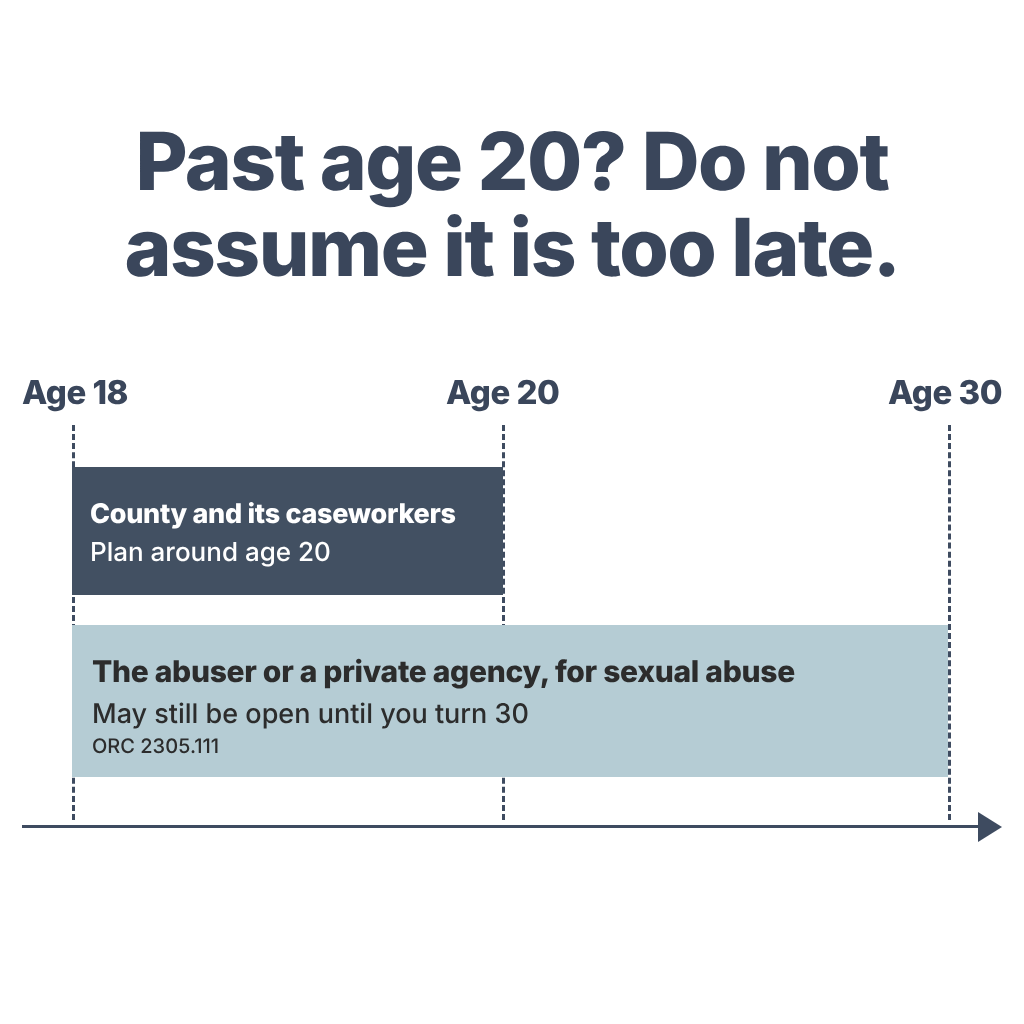
Claims against the county agency have a two-year deadline, and the clock is paused until your child turns 18. The safest course is to file any claim against the county or its caseworkers before your child's 20th birthday.
I'm a personal injury attorney at Ciano & Goldwasser, LLP, with a focus on sex abuse cases, including claims against institutions that failed in their duty to protect a child. I also serve on the Board of Directors of the Cleveland Rape Crisis Center and chair its governance committee.
Is children services immune from lawsuits in Ohio?
Ohio's immunity law protects counties and other local government bodies (ORC 2744.01), and Ohio courts apply it to county children services agencies. Under ORC 2744.02, the agency cannot be held liable for injuries connected to its work unless one of five exceptions applies.
Four of those exceptions cover things like car accidents, public roads and defective buildings, so they rarely fit a child abuse case. The fifth applies when another Ohio law says outright that the agency is liable. A law that only tells the agency what it must do, without saying it is liable when it fails, is not enough.
What if you reported abuse and children services did nothing?
Ohio law requires the county agency to investigate each report of child abuse or neglect within 24 hours, with a few exceptions (ORC 2151.421). If the agency ignored your report, or left your child in a dangerous home, you generally still cannot sue the agency itself. What you reported, and what the caseworkers did with it, is the evidence for a claim against the caseworkers personally.
The reason is a 2001 Ohio Supreme Court decision, Marshall v. Montgomery County Children Services Board. The court held that the law requiring investigations does not say the agency is liable when it fails to investigate, so the agency keeps its immunity. The court called that result "troubling," because it means an agency could ignore duties the law gives it and still avoid a lawsuit. But it decided the case under the law as written. Marshall is still the rule in Ohio.
Does it matter that the county placed your child in foster or kinship care?
Taking a child into custody, or placing a child in a foster or kinship home, does not remove the agency's immunity under Ohio law. In Rankin v. Cuyahoga County Department of Children and Family Services (2008), a girl in the agency's temporary custody was sexually assaulted by her father during a supervised visit at an agency service center. Her family sued, alleging the agency failed to protect her. A lower court let the case go forward on the theory that the agency had a "special relationship" with her. The Ohio Supreme Court disagreed and held the agency immune, because a special relationship is not one of the exceptions written into the immunity law.
Ohio appeals courts have reached the same result for foster and kinship homes. In T.B. v. Summit County Children Services Board (2019), two children were placed in the home of a foster father who was later convicted of sexually abusing them. In M.F. v. Perry County Children Services (2019), two children in a kinship placement were sexually abused by an adult grandson living in the home. Both courts held the agency immune.
Custody or a foster placement can, however, make a federal civil rights lawsuit possible.
Can you sue the caseworker personally?
A caseworker, supervisor or agency director can be sued personally, but agency employees have their own immunity under ORC 2744.03. It protects them unless the employee:
clearly acted outside their job;
acted "with malicious purpose, in bad faith, or in a wanton or reckless manner"; or
is made liable by another Ohio law that says so outright.
What has to be proven against a caseworker
In most cases, you would have to show that the caseworker acted recklessly, which is a high bar. The Ohio Supreme Court describes reckless conduct as "conscious disregard of or indifference to a known or obvious risk of harm to another that is unreasonable under the circumstances and is substantially greater than negligent conduct." Ordinary carelessness is not enough. The caseworker had to know your child faced a serious risk, or the risk had to be obvious, and the caseworker disregarded it.
Whether a caseworker was reckless depends on what they knew and when: what reports came in, what they were told and what they did next. In the Summit County case, T.B., the children's mothers reported the abuse, the caseworkers were allegedly dismissive, and one boy was returned to the foster home after he disclosed the abuse. The appeals court held that there was a real dispute over whether three agency employees had acted recklessly or in bad faith, so the claims against them could go forward. In the Perry County case, M.F., nothing showed that the caseworkers knew or had reason to suspect the abuse before the children disclosed it, and the claims against them ended.
When the evidence could support either answer, a jury decides. In Smathers v. Glass (2022), a trial court had ruled for Perry County caseworkers and their director before trial. The Ohio Supreme Court reversed. It held that at that stage, the question is whether "reasonable minds could find" that the employees acted recklessly, and it sent the case back for trial. The decision did not find the caseworkers liable.
Can you bring a federal lawsuit against children services?
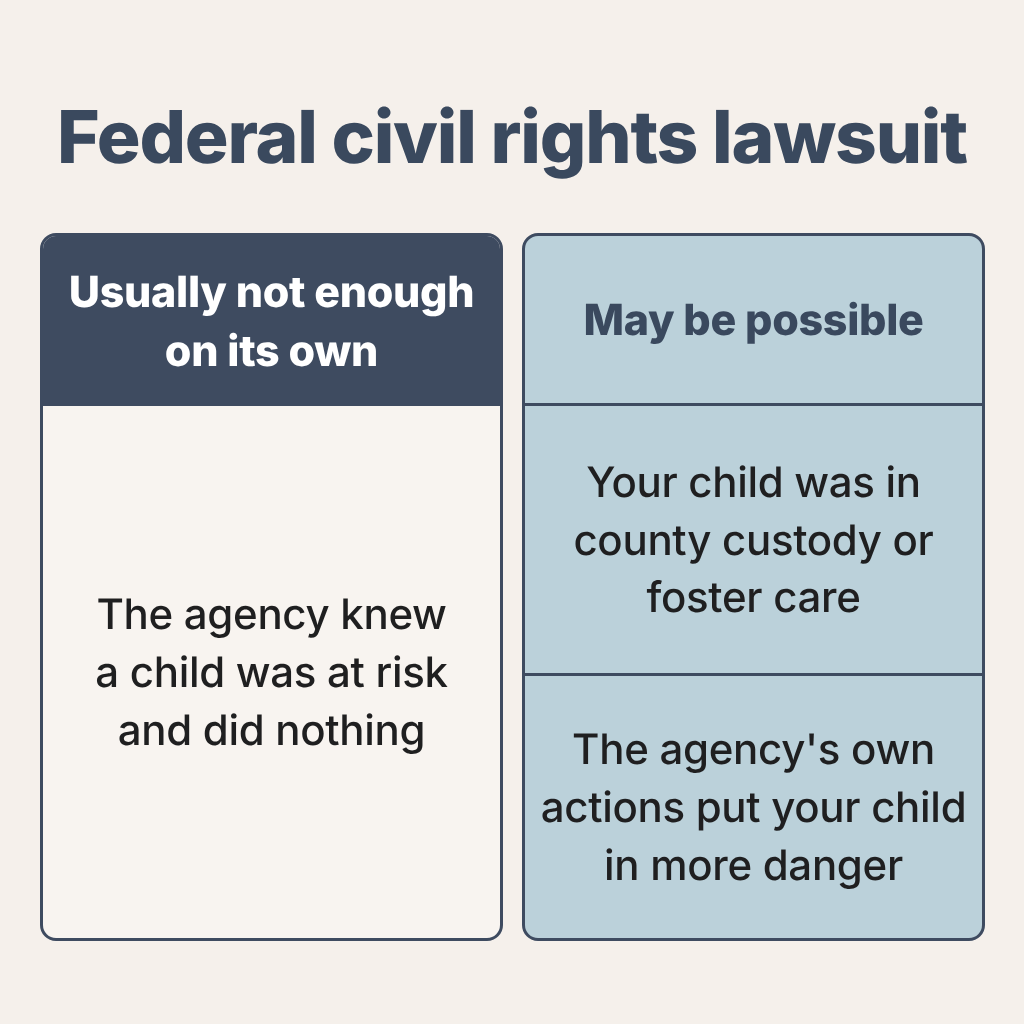
A federal civil rights lawsuit against caseworkers or the county may be possible if your child was in county custody or foster care, or if the agency's own actions put your child in more danger. Ohio's immunity law does not apply to federal claims (ORC 2744.09). These lawsuits are brought under a federal law, 42 U.S.C. 1983, that allows people to sue state and local officials who violate their constitutional rights.
Federal claims are limited to those situations because of a 1989 U.S. Supreme Court decision, DeShaney v. Winnebago County Department of Social Services. The Court held that "a State's failure to protect an individual against private violence simply does not constitute a violation" of the Constitution. The government takes on a duty to protect someone, the Court said, when it takes away that person's freedom to protect themselves, such as by taking them into custody. So an agency that knew a child was at risk and did nothing usually cannot be sued under federal law for that alone.
When your child was in county custody or foster care
DeShaney left open whether a child the government places in foster care is owed that duty to protect. The Sixth Circuit Court of Appeals, whose decisions bind federal courts in Ohio, answered that question in Meador v. Cabinet for Human Resources (1990). It held that children in state-regulated foster homes have a constitutional right "to be free from the infliction of unnecessary harm." It also let a claim go forward against officials accused of ignoring reports that the children were being abused. That rule covers children placed in foster care by an Ohio county. The court has since made clear that it covers only harm that happens while the child is in the government's custody (Lipman v. Budish).
When the agency's own actions put your child in more danger
Even when your child was living at home, a federal claim may be possible if a caseworker did something, rather than failed to do something, that made the danger worse. Courts call this a "state-created danger." In Lipman (2020), the child lived with her mother and was not in county custody. Caseworkers interviewed her in front of her alleged abusers. The Sixth Circuit treated that interview as an act that could have increased the danger to her, and it allowed the claim to go forward.
Why federal claims against children services are hard to win
Federal claims against caseworkers are hard to win even when the facts fit, because caseworkers can raise a defense called qualified immunity (Harlow v. Fitzgerald). It protects government officials from paying damages unless they violated a "clearly established" right. Courts look for an earlier decision that made the rule clear, the way Meador did for children in foster care in 1990.
The county itself can be sued under federal law, but only when its own policy or custom caused the harm, not simply because it employed the caseworker (Monell v. Department of Social Services). In a 2013 case, for example, a federal court let a claim against Trumbull County's agency go forward. The agency allegedly allowed a child in its custody to have unsupervised visits with a father it knew was a sex offender, under visitation guidelines it had adopted as official policy (Doe v. Trumbull County Children Services Board). That ruling came at the start of the case and did not decide whether the allegations were true.
A 2025 decision, R.S. v. Lucas County Children Services, shows how these claims can fail. The agency removed two children from their mother and placed them with her pastor and his wife, and the children were abused in that home. The Sixth Circuit ruled for two caseworkers. It found that the state's child welfare records did not warn the caseworkers of a serious risk to the children. It also found that the family had not shown that the children's rights were clearly established. The decision is unpublished, so it does not bind other courts.
Who else can be held responsible for the abuse?
Several others can be held responsible, and the county's immunity does not protect them from these claims.
The person who abused your child
The person who abused your child can be sued for assault and battery. Ohio law also allows "anyone injured in person or property by a criminal act" to recover full damages in a civil lawsuit (ORC 2307.60), and the Ohio Supreme Court held in Buddenberg v. Weisdack (2020) that this claim does not require a criminal conviction. These claims can be brought against a foster parent, relative or anyone else in the home who abused your child.
Foster parents, school employees and others who failed to report
The same law that requires the agency to investigate also requires certain adults to report suspected abuse they learn of in a professional or official role. They include foster caregivers, teachers and other school employees, and peace officers. Unlike the agency's duty to investigate, the duty to report comes with liability written into the law: anyone who fails to make a required report is liable for damages to the child.
In Campbell v. Burton (2001), the Ohio Supreme Court held that a school board and its employees could not use immunity to defeat a claim that they failed to report suspected abuse. Our article on suing an Ohio school district for sexual abuse by a teacher explains how these claims work against schools.
Private foster care agencies and group homes
Some foster homes and group homes are run or supervised by private agencies rather than the county. Ohio's immunity law covers counties and other public bodies, and a private agency is not one of them. That means a claim against a private agency does not require proof of recklessness. Carelessness can be enough.
A private agency can be sued for negligence, which means failing to use reasonable care to protect the children in its care. It can also be sued for negligent hiring and supervision, such as hiring staff it should have known were dangerous or failing to supervise them. Our pages on child sexual abuse cases and institutional sexual abuse cover claims against organizations that failed to protect children.
How long do you have to sue children services in Ohio?
The deadline depends on who you are suing and what kind of abuse happened.
| Who you are suing | Deadline for abuse before age 18 |
|---|---|
| The county agency, under Ohio law | About age 20: 2 years, paused until 18 (ORC 2744.04, ORC 2305.16) |
| Caseworkers or the county, under federal civil rights law | About age 20: 2 years, paused until 18 (Browning v. Pendleton, Sixth Circuit, 2010) |
| The abuser, for sexual abuse | Age 30: 12 years after 18 (ORC 2305.111) |
| A private foster care agency or other private party, for sexual abuse | Age 30: 12 years after 18 |
The age-30 rule covers claims resulting from childhood sexual abuse, not physical abuse or neglect. For other kinds of abuse, the deadline depends on the claim, so talk to a lawyer early.
Whether the age-30 rule also applies to the county is unsettled. In Watkins v. Department of Youth Services (2015), the Ohio Supreme Court said the rule covers childhood sexual abuse claims against public and private defendants alike, and it applied the rule to a state agency, the Ohio Department of Youth Services. But a state agency falls under a different deadline law than a county does. A county agency has the immunity law's own two-year deadline, and we have not found an Ohio court decision on which deadline applies to it.
The deadline for an Ohio claim against a caseworker personally is also unclear, because the two-year law is written for claims against the county, not its employees. Until these questions are settled, I recommend planning around age 20 for claims against the county and its caseworkers.
If you were the child and you are now past 20, do not assume it is too late. A claim for sexual abuse against the abuser or a private agency may still be open until you turn 30, and a lawyer can tell you whether a claim against the county or its caseworkers is still possible.
How much money can you recover, and who pays?
When a caseworker is sued in state or federal court, Ohio law requires the county to provide for the caseworker's defense and to cover any judgment against the caseworker other than punitive damages (ORC 2744.07). Neither duty applies if the caseworker was not acting in good faith or was acting outside the job.
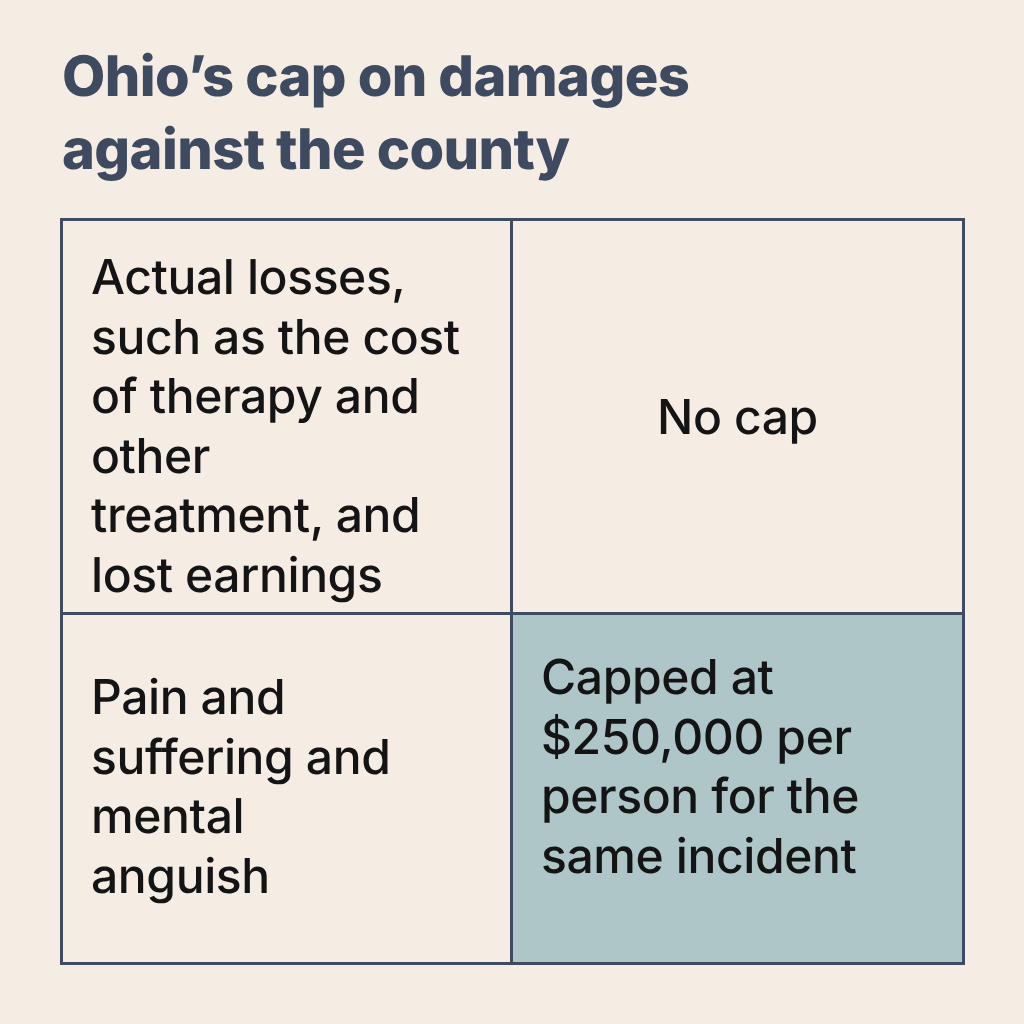
When the county itself can be held liable on an Ohio claim, which is rare, Ohio law limits what it can be ordered to pay (ORC 2744.05):
There is no cap on damages for actual losses, such as the cost of therapy and other treatment, and lost earnings.
Damages for losses that are not actual losses, such as pain and suffering and mental anguish, are capped at $250,000 per person for the same incident.
Punitive damages, which are meant to punish rather than compensate, cannot be awarded against the agency.
Benefits received from other sources for the same injuries, such as insurance, are subtracted from the award.
The cap does not tell you what a case is worth, which depends on the harm your child suffered and what the evidence shows. These limits come from Ohio's immunity law, so they do not apply to federal civil rights claims. Our page on damages in sexual abuse cases explains the kinds of losses survivors can recover.
Where can you complain about children services without suing?
The Ohio Youth and Family Ombudsmen Office takes complaints about public children services agencies and private provider agencies. Young people can contact it directly, and so can adults concerned about a child in the system. You can call 1-877-OH YOUTH (1-877-649-6884) or use the complaint forms on its website.
The office investigates and tries to resolve complaints. Its 2023 annual report says the office "was not designed to operate as either a courthouse or a law firm" and is "not authorized to investigate suspected child abuse or neglect under any circumstances."
What should you do if children services failed to protect your child?
Your child's safety comes first. After that, the most useful thing you can do is keep a record of what children services was told and what it did, because a claim against the caseworkers depends on what they knew and when.
Make sure your child is safe and the abuse has been reported. In an emergency, call 911. To report abuse, call Ohio's hotline at 855-O-H-CHILD (855-642-4453), which connects callers to their county's child welfare or law enforcement office. You can report without giving your name.
Write down every contact you had with children services: the date, who you spoke with, what you told them and what they said they would do.
Write down the names of the caseworkers and supervisors and any case numbers. If your child was placed outside your home, note where your child was placed, who at the agency made the placement and the date.
Keep every letter, notice, text and email from the agency, along with anything showing that someone warned the agency.
Talk to a lawyer well before your child turns 20. A parent who is not a licensed attorney cannot act as a child's lawyer in court.
If you or your child needs support, our resources page lists hotlines for survivors and their families.
If children services failed to protect your child, or failed to protect you when you were a child, I would like to hear what happened. I personally review every potential case, and I can help you understand who may be responsible and how much time you have. Consultations at Ciano & Goldwasser are free and confidential, with no obligation to hire us. We handle abuse and personal injury cases on a contingency basis, and under our No Fee Guarantee, you pay no fee unless we recover compensation for you. You can reach me at (216) 658-9900.