
Written By Andy Goldwasser, Managing Partner, Ciano & Goldwasser, LLP

Yes, you can sue an Ohio public school district when a teacher sexually abuses a student, but the grounds are narrower than most families expect. Ohio law protects school districts from most lawsuits, including the familiar claim that the school failed to supervise the teacher. The claims that do work against a district come down to what people at the school knew. If a teacher, counselor, principal or other employee knew or suspected the abuse and did not report it, and that failure led to the harm, the district can be held responsible.
You can also sue the teacher. For sexual abuse of a child under 18, that claim can generally be brought until the survivor turns 30. The deadline for suing the district is less certain. To be safe, talk to a lawyer about a claim against the school before the survivor turns 20.
I'm a personal injury attorney with a focus on sex abuse cases at Ciano & Goldwasser, LLP. I also serve on the Board of Directors of the Cleveland Rape Crisis Center, where I chair its governance committee.
Aren't Ohio public schools immune from lawsuits?
Ohio public school districts have broad immunity from lawsuits. That immunity has exceptions, and one of them applies to teacher abuse cases. Ohio's immunity law treats a school district as a "political subdivision," the same category as a city, township or county (ORC 2744.01). A political subdivision cannot be held liable for injuries except in the situations the statute lists (ORC 2744.02).
Most of those exceptions cover things like car accidents and unsafe buildings. The one that matters in abuse cases applies when "civil liability is expressly imposed upon the political subdivision by a section of the Revised Code". That means another Ohio law has to say outright that the district is liable when it breaks that law. A law that only tells the school what it must do, without saying the school is liable when it fails, does not let you sue the district.
Claims that a public district was careless usually fail because of this rule. In August 2026, the Tenth District Court of Appeals, which covers Franklin County, decided M.S. v. South-Western City School District, a former student's lawsuit over abuse by her teacher. The court held the district immune from her negligent supervision and other negligence claims, because none of the immunity law's exceptions applied to them. Private and parochial schools are not political subdivisions, so this immunity does not protect them. Against a private school, you can bring negligence claims, including negligent hiring and supervision.
What claims can you bring against a school district for teacher abuse?
Two claims hold up against an Ohio public school district: a state claim that school employees failed to report the abuse, and a federal claim under Title IX. Both depend on what someone at the school knew. For a broader look at the civil claims survivors can bring against schools, churches and other institutions, see our guide to sexual assault victims' rights in Ohio.
Failure to report abuse under Ohio law
Ohio's mandatory reporting law is the main exception to a district's immunity. Under ORC 2151.421, teachers, school employees and school authorities who, in their jobs, know of or have reasonable cause to suspect abuse or neglect of a child under 18 must "immediately" report it to children services or the police. The same statute makes anyone who fails to report liable to the child for damages. That is the express liability the immunity law requires.
The Ohio Supreme Court has applied this rule to school districts for more than two decades. In 2001, the court held that a school board is not immune when the board or its employees violated the reporting requirements. In Yates v. Mansfield Board of Education (2004), the court held that a board of education can be liable when its failure to report a teacher's abuse of one student leads to that same teacher abusing another student.
The Tenth District Court of Appeals confirmed the rule in the same August 2026 M.S. case. The former student's eighth-grade English teacher had later pleaded guilty to two felony counts. The court held that the district could be sued for failing to report the abuse. It also said the Supreme Court's 2001 and 2004 decisions are still the law Ohio courts must follow.
In practice, a failure-to-report case turns on who at the school knew or suspected the abuse, and when. The duty to report starts with reasonable suspicion, not certainty. An earlier complaint from another student, something a child told a counselor, or behavior a coworker noticed can show that an employee had reason to suspect abuse and should have reported it. If the district investigated the teacher and then let the teacher resign, school officials knew of the allegations. A judge or jury would then decide whether those officials reported the allegations to children services or the police.
Title IX lawsuits for teacher sexual abuse
Title IX gives you a second route against a district. It is the federal law that bars sex discrimination in education. The U.S. Supreme Court has recognized that a teacher's sexual harassment of a student, including sexual abuse, can support a Title IX claim against the school district. Under Gebser v. Lago Vista Independent School District (1998), a district owes damages only if an official with at least the authority "to institute corrective measures" on the district's behalf actually knew of the teacher's misconduct and was deliberately indifferent to it. The Court described deliberate indifference as an official decision not to fix the problem.
It is not enough that the teacher worked for the district, or that the school should have known about the misconduct. In McCoy v. Board of Education, Columbus City Schools, a family sued after a teacher was accused of touching a boy. School officials knew of earlier incidents involving the teacher, and the school had reprimanded him for them. Those incidents involved non-sexual physical contact, and the court found that "the nature and severity" of the teacher's misconduct was not apparent to school officials. In 2013, the Sixth Circuit Court of Appeals, the federal appeals court over Ohio, ruled that the district had not been deliberately indifferent, and the family's case was dismissed. "In hindsight, the school district could certainly have done more," the court wrote, as Education Week reported. "But this is not the standard by which we impose liability."
Can you sue the teacher who abused your child?
Yes, you can sue the teacher directly. Public employees in Ohio have their own immunity from lawsuits. Under ORC 2744.03, that immunity does not apply when:
the employee's acts were clearly outside the scope of the job;
the employee acted with malicious purpose, in bad faith, or recklessly; or
another Ohio statute expressly makes the employee liable.
A teacher who sexually abuses a student can fall within these exceptions.
Claims against the teacher usually include assault and battery and a claim under ORC 2307.60, which says "anyone injured in person or property by a criminal act" may recover full damages in a civil action.
You do not need a criminal conviction to sue. In Buddenberg v. Weisdack (2020), the Ohio Supreme Court held that a claim under ORC 2307.60 does not require one. A conviction can be used as evidence, but the civil case is separate from any criminal case, and it can go forward even if prosecutors never file charges. Our article on what kind of attorney handles sexual abuse cases explains more about how the two cases differ.
Can you sue the principal or other administrators?
A principal or other administrator can be sued personally when one of the same three exceptions applies. Ohio's failure-to-report law is a statute that expressly makes an employee liable, because it makes the person who failed to report liable to the child. In the M.S. case, the court said "a jury could find" that the former principal "knew about [the teacher's] behavior or willfully remained blind to it," so it refused to dismiss the claims against the principal before trial.
How long do you have to sue a school district in Ohio?
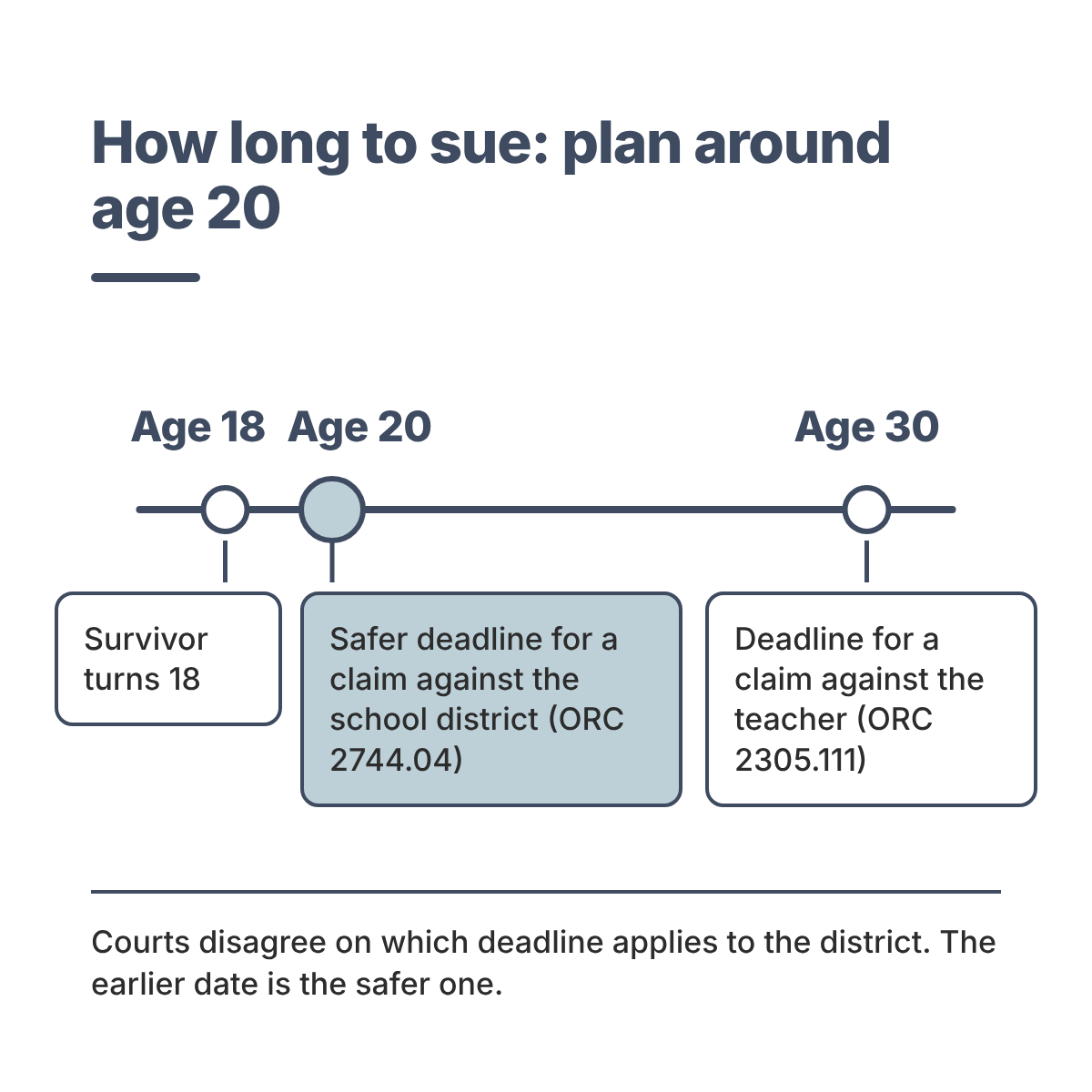
To be safe, plan on bringing any claim against a public school district, including a Title IX claim, before the survivor's 20th birthday. Claims against the teacher for sexual abuse that happened before the survivor turned 18 can generally be brought until age 30. The deadline for the district is not settled, which is why the earlier date is the safer one.
| Claim | Against whom | Deadline |
|---|---|---|
| Childhood sexual abuse claims, ORC 2305.111(C) | The teacher, and possibly the school district | 12 years after the survivor turns 18, so until age 30 |
| Claims against a political subdivision, ORC 2744.04(A) | The school district | 2 years, paused while the survivor is a minor, so about age 20 |
| Title IX | The school district | Courts disagree: 2 years from age 18 (about age 20), or 12 years from age 18 (until age 30) |
Note: a district may argue that the two-year rule for political subdivisions applies to claims against it, while a survivor may argue that the 12-year rule does.
Ohio's 12-year rule covers sexual abuse by a teacher or other person in authority at a school. More precisely, it covers claims resulting from the sexual offenses the statute lists when they are committed against a child under 18. It does not cover abuse that happened after the survivor turned 18. Courts have applied the rule to claims against institutions, not only abusers. The Ohio Supreme Court applied it to a claim against the State of Ohio in Watkins v. Department of Youth Services (2015), and an Ohio appeals court applied it to a claim against a private school in S.A.S. v. Wellington School (2020). We have not found an Ohio court decision that settles which deadline applies to a public school district.
Federal courts in Ohio also disagree about which deadline applies to Title IX. Title IX has no deadline of its own, so courts borrow one from Ohio law. In a 2024 decision, one federal court in Ohio used Ohio's two-year deadline for personal injury claims, paused it until the survivor turned 18, and so ended it around age 20. A 2021 decision from another federal court in Ohio reached a different answer and applied the 12-year rule. The 2024 court said that earlier decision was wrong, so federal courts in Ohio have now gone both ways.
In September 2026, Sen. Bill Blessing and Rep. Rachel Baker announced plans for a bill to end Ohio's civil deadline for childhood sexual abuse claims, but that bill is not law.
What money can a family recover from a school district?
Ohio limits what a public school district can be ordered to pay, but those limits do not apply to your family's actual financial losses. Under ORC 2744.05:
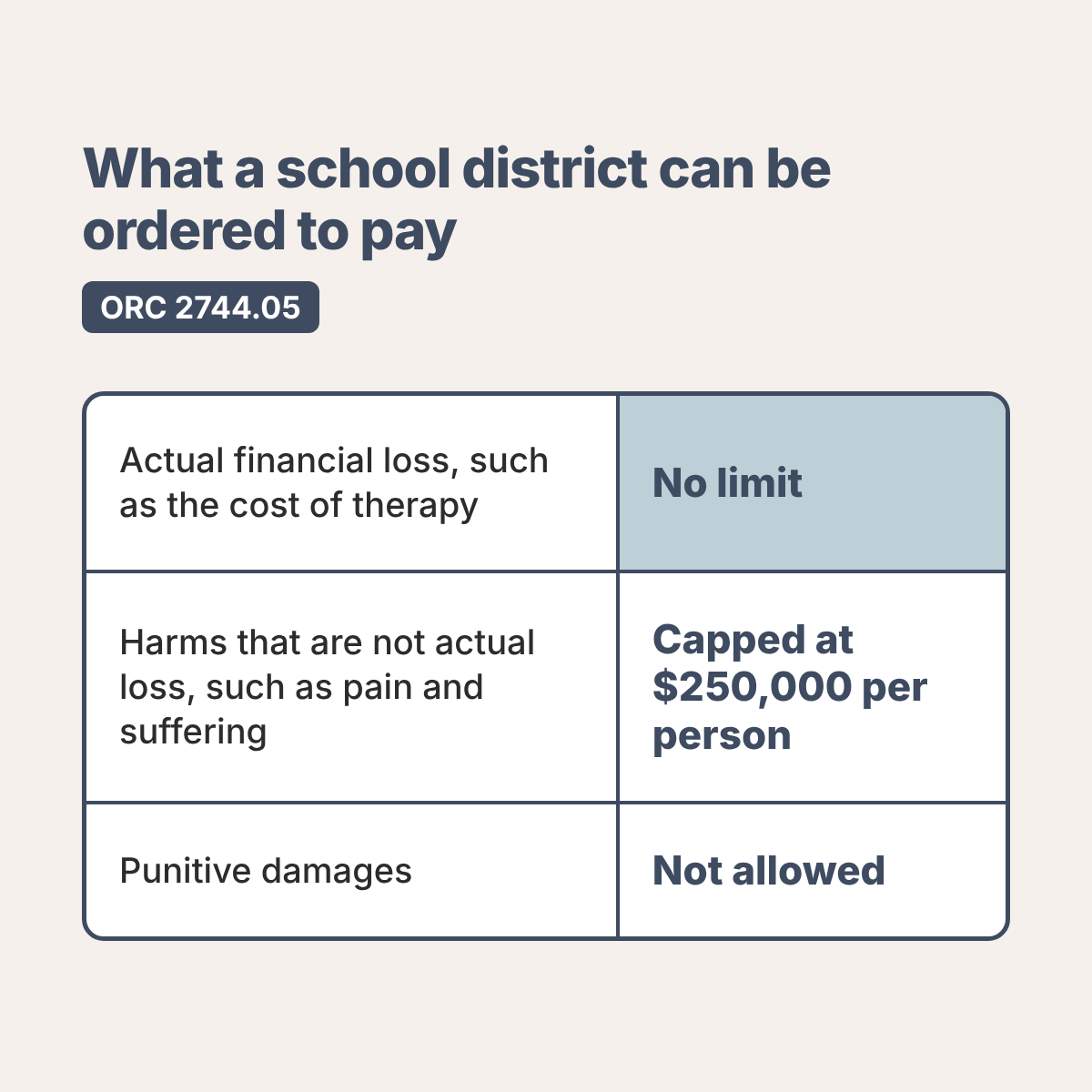
There is no limit on damages for actual loss, such as the cost of therapy.
Damages for harms that are not actual loss, such as pain and suffering, are capped at $250,000 per person.
Punitive or exemplary damages, which are meant to punish a wrongdoer rather than compensate the survivor, cannot be awarded against a district.
Have Ohio school districts settled teacher abuse cases?
Ohio school districts have settled claims by students abused by teachers. A settlement is not a court finding that the district was responsible.
Springboro (Warren County): A gym teacher was convicted in June 2020 of 34 counts of gross sexual imposition involving first-grade girls. In settlements reported in September 2023, the district's insurer paid $3.5 million to the parents of 32 students, with nearly every student's share at $109,576 before attorney fees and expenses.
Olentangy (Delaware County): Three girls were abused by a second-grade teacher at Arrowhead Elementary, who was convicted in 2016. By June 2018, two of them had settled with the district for a total of $360,000, and the third settlement was pending.
Solon (Cuyahoga County): Three former students received $85,000 each from the district's insurer over abuse by the high school band director. Their lawsuit alleged that the principal and a former assistant principal were "deliberately indifferent." The district denied wrongdoing.
What should I do if a teacher abused my child?
Your first steps protect your child and the evidence a case will depend on. The same steps apply if you are an adult who was abused by a teacher as a student.
Make sure your child is safe and that the abuse has been reported to children services or the police.
Write down who at the school knew what, and when. Include earlier complaints, comments from other parents or students, and any behavior that, looking back, may have been grooming.
Keep everything: texts, social media messages, school emails, report cards and any letters from the district.
Do not sign anything from the district or its insurer before you get legal advice.
Talk to a lawyer early. A claim against the district may need to be filed before the survivor's 20th birthday. Building a case around who knew what also takes time. Our guide to choosing a sexual assault attorney in Ohio covers what to look for.
If a teacher abused your child, or abused you when you were a student, I would like to hear what happened and help you understand which claims fit your situation and how much time you have. Consultations at Ciano & Goldwasser are free and confidential. We handle sexual abuse cases on a contingency basis, and under our No Fee Guarantee, you pay no fee unless we win. You can reach me at (216) 658-9900 or learn more about our sexual assault victim representation.