How to Choose the Best Sexual Assault Attorney in Ohio
Not every personal injury attorney is equipped to handle a sexual assault case. The skills required are different, the dynamics with clients are different, and the institutional defendants these cases target require a specific kind of experience that most firms simply don't have.
If you're a survivor in Ohio considering civil legal action, the attorney you choose matters enormously. The right one will know how to build a case against the school, church, employer, or organization that failed to protect you. The wrong one may leave real accountability on the table. At Ciano & Goldwasser, we have represented survivors of sexual assault, rape, and human trafficking for over 25 years. This guide is intended to help you evaluate your options and ask the right questions before making one of the most important decisions of your case.
Why civil litigation matters when criminal charges don't
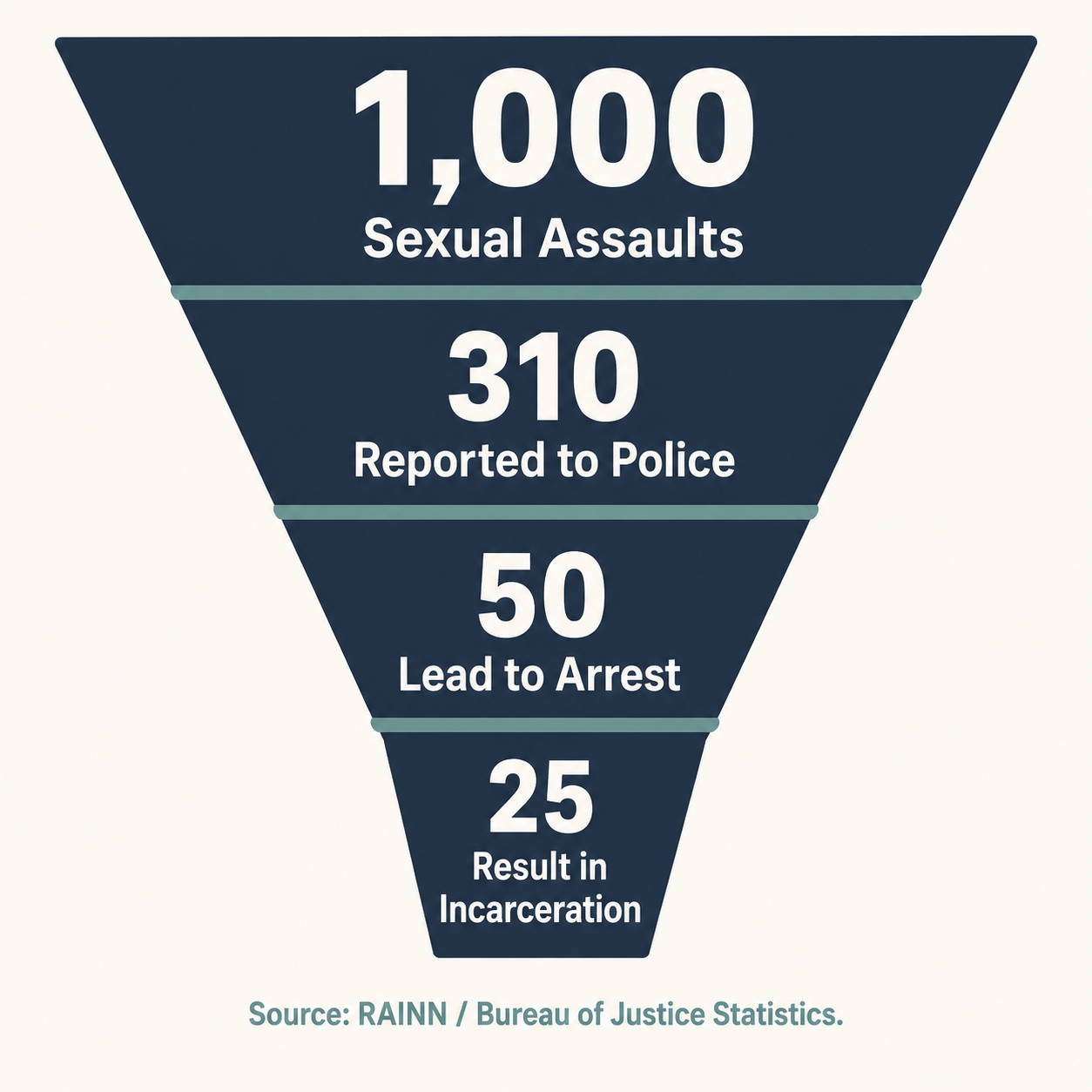
The gap between sexual violence and criminal accountability is significant. According to RAINN's analysis of Bureau of Justice Statistics data, for every 1,000 sexual assaults, only 310 are reported to police, 50 lead to arrest, and just 25 result in incarceration. A peer-reviewed systematic review of 288,066 cases found the mean conviction rate was 8.28% of reported cases.
Civil litigation operates under fundamentally different rules:
The burden of proof is "preponderance of the evidence," not "beyond a reasonable doubt"
No criminal conviction, charge, or police report is required to file a civil claim
The survivor controls the case and its direction, not the state
Civil discovery can expose institutional failures that criminal investigations never reach
Claims can be filed against not just the perpetrator, but the institutions whose negligence enabled the abuse
Research supports the personal value of civil action beyond financial recovery. A study by Cattaneo and Goodman found that empowering experiences in the court system predicted improvement in depression and quality of life at three and six months. Most survivors who pursue civil claims emphasize the symbolic value of accountability as much as any financial outcome.
What is Ohio's statute of limitations for sexual assault civil claims?
Ohio's civil statute of limitations for sexual assault is among the more restrictive nationally, which makes early legal consultation important.
| Claim Type | Deadline | Ohio Statute |
|---|---|---|
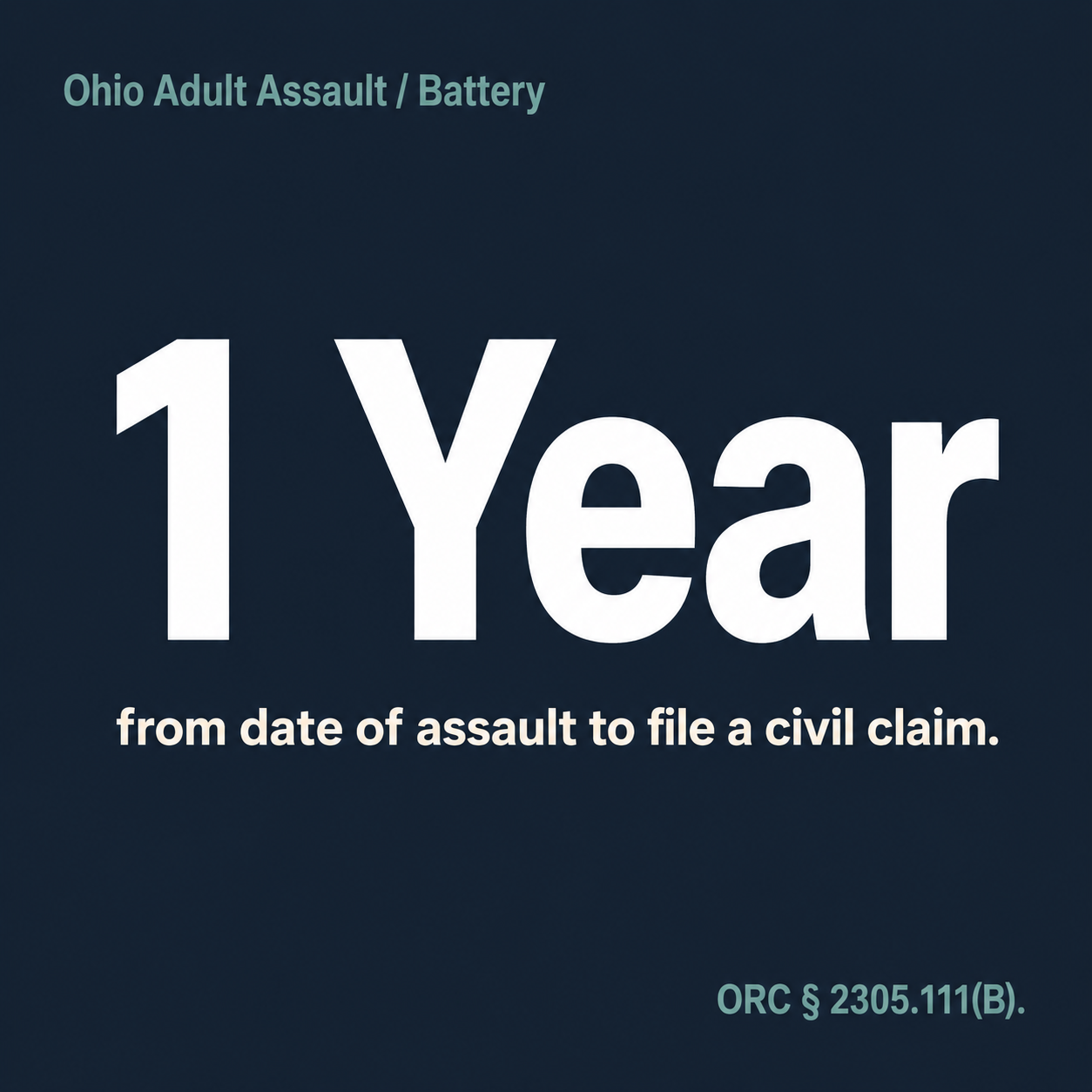
| Adult assault / battery | 1 year from date of assault | ORC § 2305.111(B) |
| General personal injury (alternative framing) | 2 years | ORC § 2305.10 |
| Childhood sexual abuse | Until the victim's 30th birthday | ORC § 2305.111(C)(1) |
| Title IX claims (federal, Ohio courts) | 2 years | ORC § 2305.10 |
The one-year deadline for adult assault claims is the most urgent. If the defendant fraudulently concealed facts underlying the claim (for abuse occurring on or after August 3, 2006), the clock can be tolled until the plaintiff discovers those facts, but this exception requires legal analysis to apply.
Ohio has considered but not passed broader reform. HB 266 in the 134th General Assembly would have extended the childhood sexual abuse civil statute to age 55 and created a revival window for previously time-barred claims. It died without a hearing, making Ohio one of only six states that still impose a criminal SOL on child sexual abuse. If you are unsure whether your claim is time-barred, a consultation with an attorney is the only way to find out.
What qualifications should a sexual assault civil attorney have?
Safe Horizon, one of the nation's largest victim services organizations, offers a useful warning: if a firm's website lists a broad range of case types (motorcycle accidents, car crashes, medical malpractice), the firm may not have genuine expertise in sexual abuse cases. General personal injury experience is a starting point, not a credential.
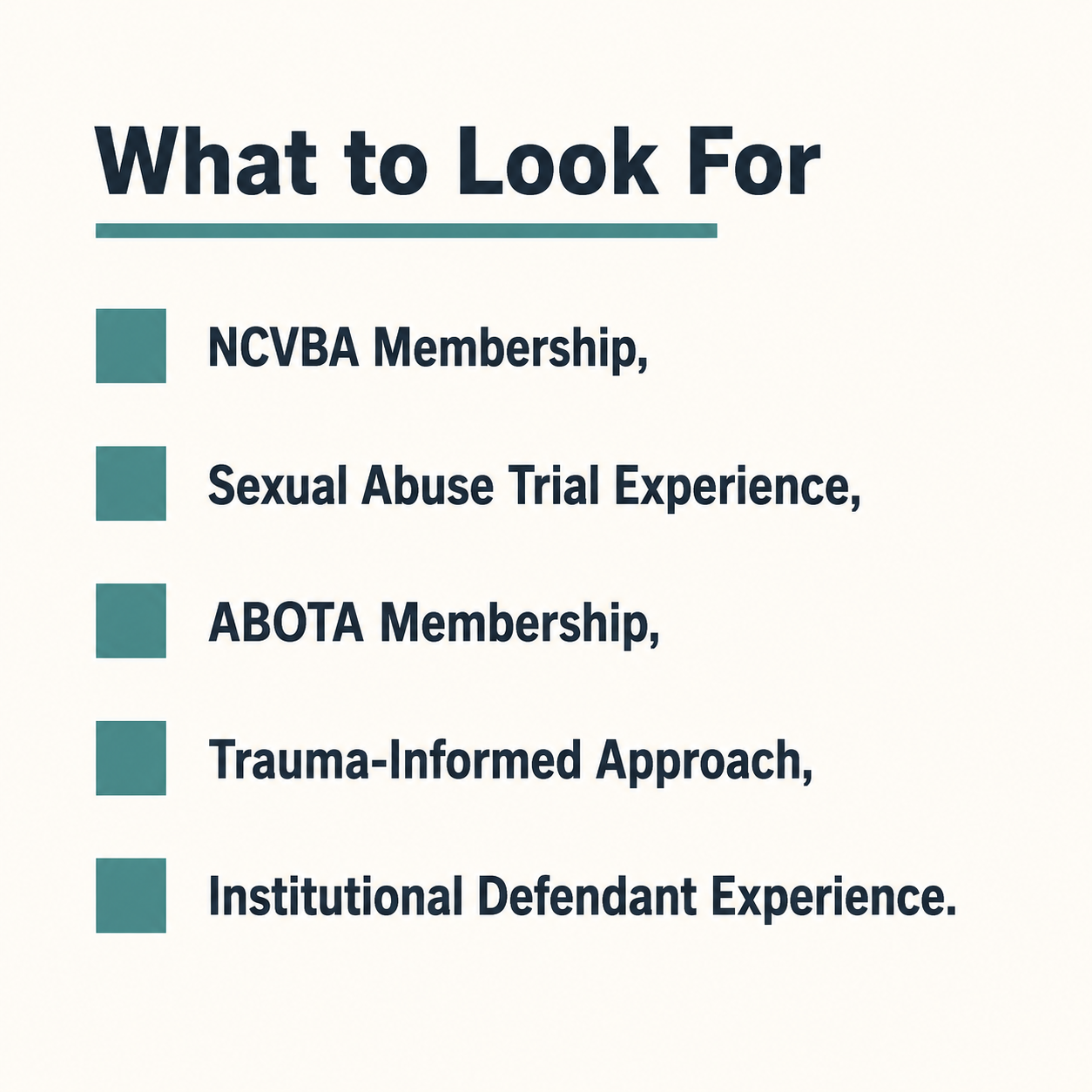
Here is what to look for instead:
Membership in the National Crime Victim Bar Association (NCVBA) The NCVBA is the nation's first professional association of attorneys dedicated specifically to helping victims pursue justice through civil courts. Membership signals genuine commitment to this area of practice.
Trial experience in sexual abuse cases specifically An attorney who primarily settles cases quickly, or who has never taken a sexual abuse case to verdict, is different from one who has tried them. Ask directly: how many sexual assault civil cases have you taken to trial, and what were the outcomes?
Membership in the American Board of Trial Advocacy (ABOTA) ABOTA requires a demonstrated record of jury trials and peer nomination for membership. It confirms the attorney has actually tried cases to verdict, not just settled them.
A trauma-informed approach to client communication The ABA's Trauma-Informed Representation Project defines this as grounded in a commitment to survivor safety, choice, collaboration, and empowerment. In practice, this means the attorney asks only what is necessary during intake, allows the client to set the pace, explains every stage before it happens, and adjusts deposition settings to reduce anxiety. An attorney who rushes through your initial call or focuses immediately on case value before hearing your story has not internalized this approach.
Experience with institutional defendants Most high-value civil sexual abuse claims are filed against the institutions that failed to prevent the abuse: schools, churches, youth sports organizations, employers, and healthcare facilities. Building these cases requires a different investigative approach and familiarity with institutional negligence standards that go beyond standard personal injury work.
Red flags and green flags when evaluating an attorney
Red flags
Pressure to sign a retainer at the first meeting
Guarantees of specific outcomes or dollar amounts (this violates ABA conduct rules)
Focuses on fees before hearing the facts of your case
Rushes through or minimizes your experience
No discussion of the emotional toll of litigation
Touts large settlements from unrelated case types like car accidents or slip and falls
Green flags
Listens more than talks during the initial conversation
Explains the legal process, timeline, and emotional realities without prompting
Has a dedicated support team trained in working with survivors
Sets realistic expectations about case strengths and weaknesses
Offers to connect you with therapeutic or advocacy resources
Can point to professional organization involvement or specific case results in this area
The ICASA Guide to Civil Lawsuits recommends survivors ask themselves after a consultation: was the attorney comfortable with and knowledgeable about sexual victimization? Did I feel like a real person and not just another case? What is my gut reaction?
What questions should I ask a sexual assault attorney before hiring?
Before committing to representation, ask each attorney these questions:
How many sexual assault civil cases have you handled, and what were the outcomes?
Will you personally handle my case, or will it be passed to associates?
What is your contingency fee percentage, and does it change if the case goes to court?
Are litigation costs deducted from my recovery before or after your fee is calculated?
If the case is unsuccessful, am I responsible for costs already incurred?
How will you keep me informed throughout the process?
How do you support clients through depositions and trial preparation?
Can sensitive matters be placed under court seal or filed under a pseudonym?
Have you ever represented the perpetrator or any entity connected to the defendant?
How do sexual assault attorneys charge?
Most plaintiff-side sexual assault attorneys work on contingency. The ICASA Guide calls this the most common and typically most beneficial arrangement for survivors. It means no fee unless the firm wins or settles the case.
| Fee Arrangement | Typical Terms |
|---|---|
| Contingency (pre-court settlement) | 33% of recovery |
| Contingency (case goes to court) | 40% of recovery |
| Range across firms | 33⅓% to 45%, varies by complexity |
| Hourly | $500+ per hour; typically not recommended for survivors |
Even under contingency, survivors are typically responsible for out-of-pocket litigation costs: court filing fees (approximately $500), expert witness fees, deposition transcripts, and process server fees. Most firms advance these costs, but policies on repayment if the case is unsuccessful vary.
The most important financial question to ask any attorney: are litigation costs deducted from the recovery before or after the attorney's percentage is calculated? This significantly affects how much the survivor actually receives.
Per ABA Model Rule 1.5(c), all contingency fee agreements must be in writing and must specify the percentage, how it changes at different stages, and how expenses are handled.
Ohio's legal tools for civil sexual assault claims
Ohio provides several legal avenues for civil claims, each with distinct advantages.
Negligence
Negligent Hiring and Supervision
Assault and Battery
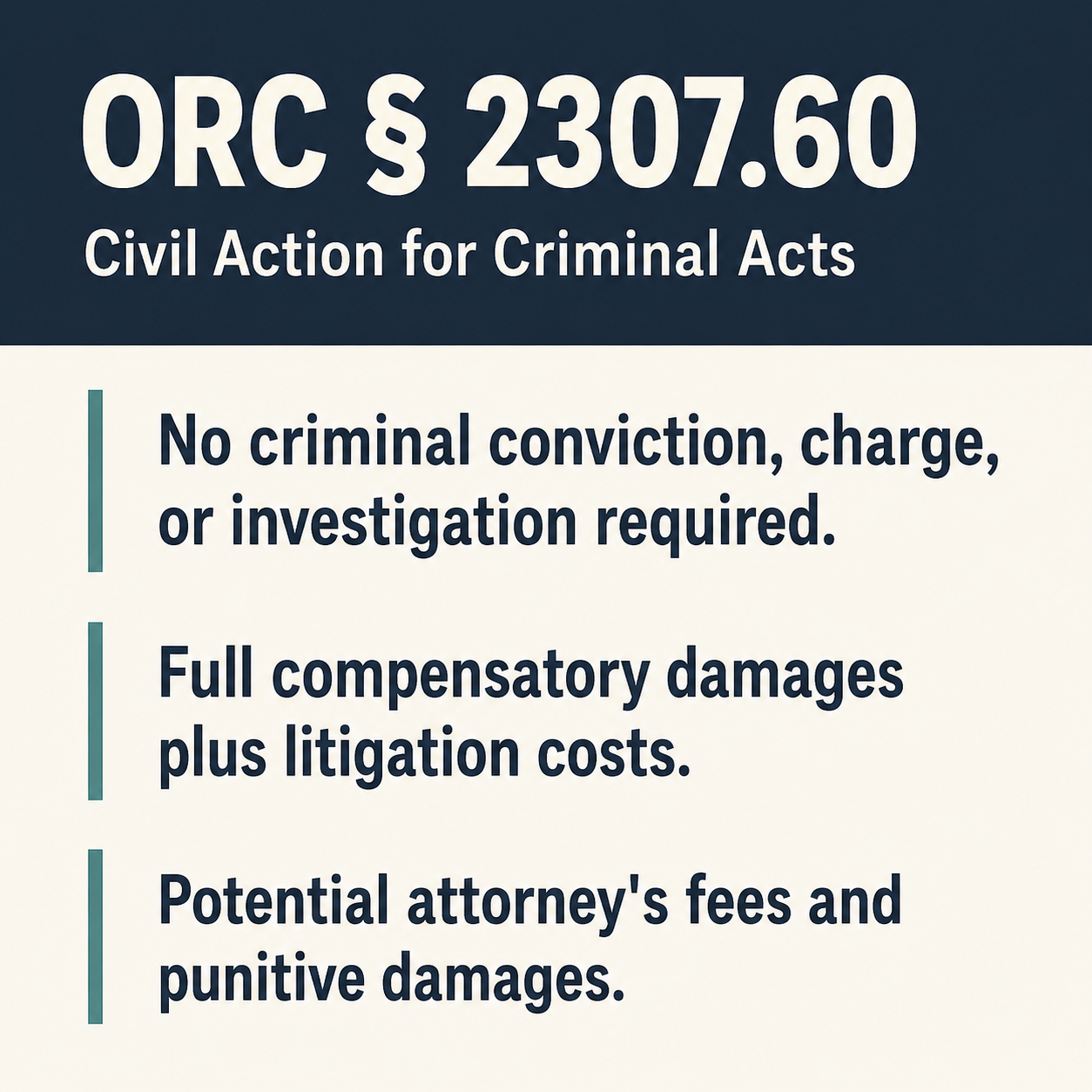
ORC § 2307.60 This is the most powerful statutory tool available to Ohio survivors. Following the Ohio Supreme Court's 2016 decision in Jacobson v. Kaforey, this statute creates an independent civil cause of action for damages resulting from any criminal act, including sexual assault, regardless of whether the perpetrator has been convicted, charged, or investigated. It permits recovery of full compensatory damages, litigation costs, and potentially attorney's fees and punitive damages.
Damages available in Ohio Ohio's damages framework includes:
Uncapped economic damages: medical expenses, therapy, lost wages, and lost earning capacity
Noneconomic damages (pain and suffering, mental anguish): generally capped at the greater of $250,000 or three times economic loss, up to $350,000 per plaintiff
Punitive damages: require clear and convincing evidence of malice or egregious conduct, generally capped at two times compensatory damages
Title IX For survivors assaulted in educational settings receiving federal funding, Title IX provides an additional avenue. Schools can be held liable when they had actual knowledge of harassment, the harassment was severe and pervasive, and the school responded with deliberate indifference. Ohio State University's Strauss litigation, where 304 survivors received more than $60 million in settlements, illustrates the scale of what institutional abuse cases can involve.
What happens during an initial consultation?
Most plaintiff-side sexual assault attorneys offer free initial consultations, typically by phone. Attorney-client privilege protects everything discussed, even if you do not hire the attorney. You are not required to describe the abuse in explicit detail, and you are under no obligation to file a lawsuit.
The attorney will likely ask about the type of harm suffered, when and where it occurred, the identity of the perpetrator, any institutions involved, whether you have sought medical or psychological treatment, and whether a criminal report has been filed.
What to bring or have ready:
A general timeline of events
Any documents or evidence you have (police reports, medical records, texts, emails)
A list of questions
A support person, if you would like one (confirm with the attorney first)
Ohio resources for survivors seeking legal help
Several organizations provide free legal assistance, referrals, and advocacy for Ohio survivors:
Ohio Crime Victim Justice Center (OCVJC): Free legal representation across Ohio. Phone: (614) 848-8500. Website:ocvjc.org
Ohio Alliance to End Sexual Violence (OAESV): Statewide coalition with alegal clinic offering virtual attorney office hours. Phone: (888) 886-8388
Ohio Sexual Violence Helpline: 24/7 confidential support. Phone: 844-644-6435. Website:ohiosexualviolencehelpline.com
Ohio Crime Victims Compensation Program: Up to $50,000 for crime-related expenses including medical and counseling costs. Application deadline is 3 years from the crime date. Phone: 1-877-584-2846. Website:ohiocourtofclaims.gov
Cleveland Metropolitan Bar Association LRIS: Lawyer referral for Cuyahoga County. Phone: (216) 696-3532
RAINN National Sexual Assault Hotline: 1-800-656-HOPE (4673), available 24/7
To verify an Ohio attorney's license and check for any disciplinary history, use the Supreme Court of Ohio's attorney directory.
Talk to a sexual assault attorney in Ohio
At Ciano & Goldwasser, Andy Goldwasser has spent over 25 years representing survivors of sexual assault, rape, and human trafficking, filing civil claims against the institutions, businesses, schools, sports organizations, and churches that failed to protect the people in their care. He has tried numerous cases and is widely regarded as a leader in the field. In June 2024, Andy secured a $4.2 million jury verdict against the United States Twirling Association in the Eastern District of New York, recognized as the 35th Highest Verdict in New York in 2025.
Quenna Bell, our Office Manager and Lead Paralegal who has worked alongside Andy for approximately 20 years, is a certified Cleveland Rape Crisis Center Ambassador. Andy serves on the Board of Directors of the Cleveland Rape Crisis Center and chairs its governance committee. He is a member of the National Crime Victim Bar Association. That involvement directly shapes how we handle cases and support clients.
All representation is on a contingency basis. There are no upfront costs, and no fee unless we recover compensation for you.
If you are considering a civil claim and want to talk through your options, contact us at (216) 658-9900 or reach out through our website for a free, confidential consultation. You can also visit OhioSexAbuseLawyer.com for more information about our sexual abuse survivor representation in Ohio.