
What Kind of Attorney Handles Sexual Abuse Cases? (2026)

Sexual abuse cases are handled by personal injury attorneys who bring civil claims on behalf of survivors. If you or someone you love is considering legal action, the lawyer you are looking for is a plaintiff-side civil attorney, and specifically one with substantial experience in sexual abuse litigation. That last part matters, because most personal injury lawyers have never handled a sexual abuse case. These claims involve institutional defendants, strict filing deadlines, privacy motions, and trauma-informed client support that a typical accident practice never touches.
At OhioSexAbuseLawyer.com, this is the work Andy Goldwasser has built his practice around. Andy is a personal injury lawyer with a focus on sex abuse cases, and in June 2024 he helped win a $4.2 million jury verdict against the United States Twirling Association after the jury found the national organization 88% responsible for the sexual assault of a 17-year-old athlete. The verdict was against the organization that failed to protect her, which is exactly what civil sexual abuse litigation exists to do.
This guide explains the difference between criminal and civil cases, what a sexual abuse lawyer actually does, what it costs, and how to tell whether an attorney is qualified for this work.
Criminal Case vs. Civil Claim: What's the Difference?
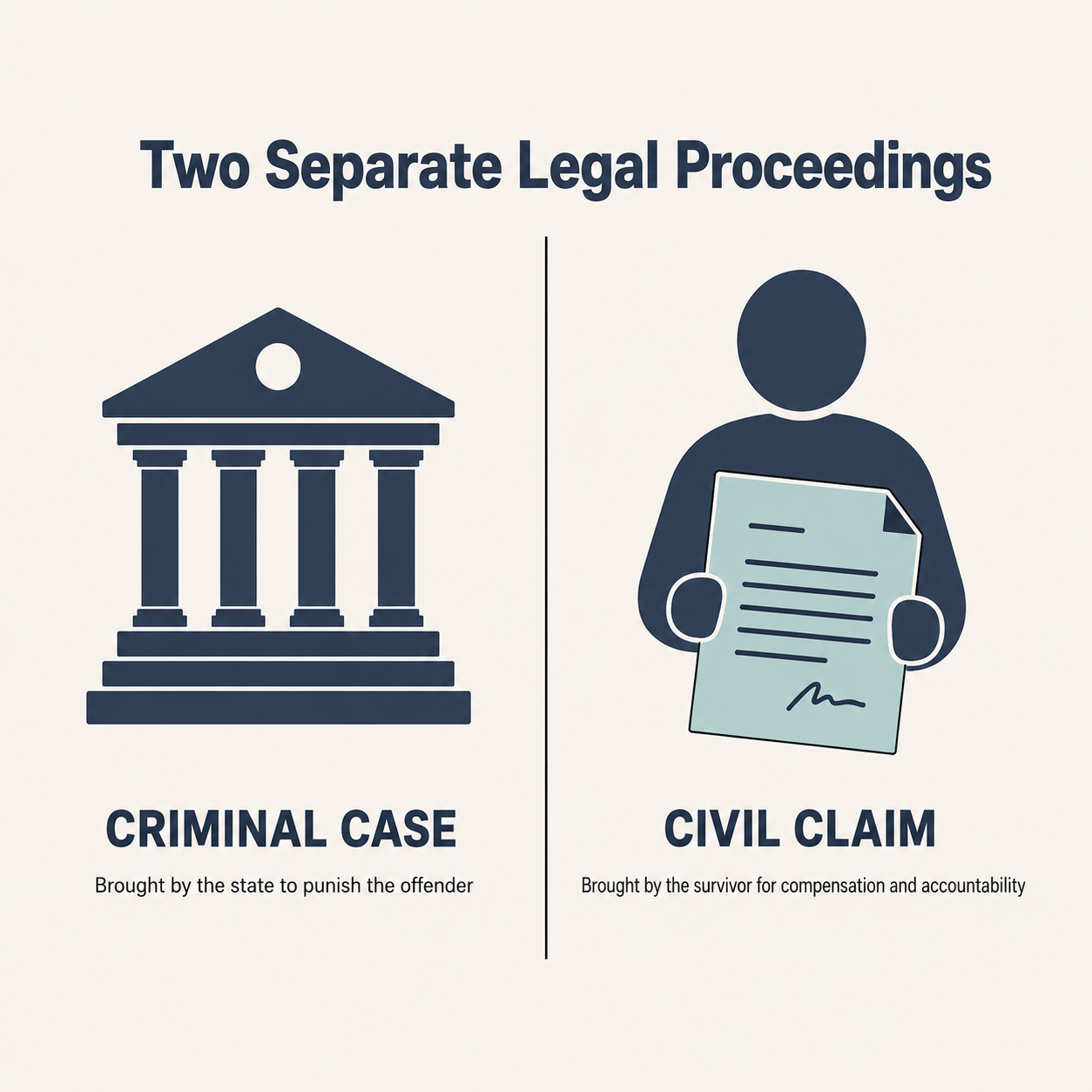
A criminal case and a civil sexual abuse claim are two separate legal proceedings. Knowing the difference tells you which kind of lawyer you need.
The criminal case is brought by a prosecutor on behalf of the state. Its purpose is to punish the offender. The survivor is a witness in that case, not a party, and does not control whether charges are filed.
The civil claim belongs to the survivor. It is filed by the survivor's own lawyer, and its purpose is to secure compensation and hold accountable everyone whose failures allowed the abuse to happen.
| Factor | Criminal Case | Civil Claim |
|---|---|---|
| Who brings it | A prosecutor, on behalf of the state | The survivor, through their own attorney |
| Goal | Punish the offender (jail, probation, fines) | Compensation for the survivor and accountability from responsible parties |
| Who can be held responsible | The individual offender | The offender and the institutions that failed to protect the survivor |
| Standard of proof | Beyond a reasonable doubt | Preponderance of the evidence (more likely than not) |
| Who decides whether to proceed | The prosecutor | The survivor |
Prosecutors handle the criminal side. For the civil side, you need your own attorney.
Do You Need a Criminal Conviction to File a Civil Claim?
No. A civil sexual abuse claim does not require a criminal conviction, an arrest, or even that charges were ever filed. Ohio law states this directly: for civil purposes, a court does not need to find that anyone was convicted of or pleaded guilty to the underlying offense (Ohio Revised Code 2305.111).
Because the civil standard of proof is lower, the same facts can result in no criminal conviction and still support a finding of civil liability.
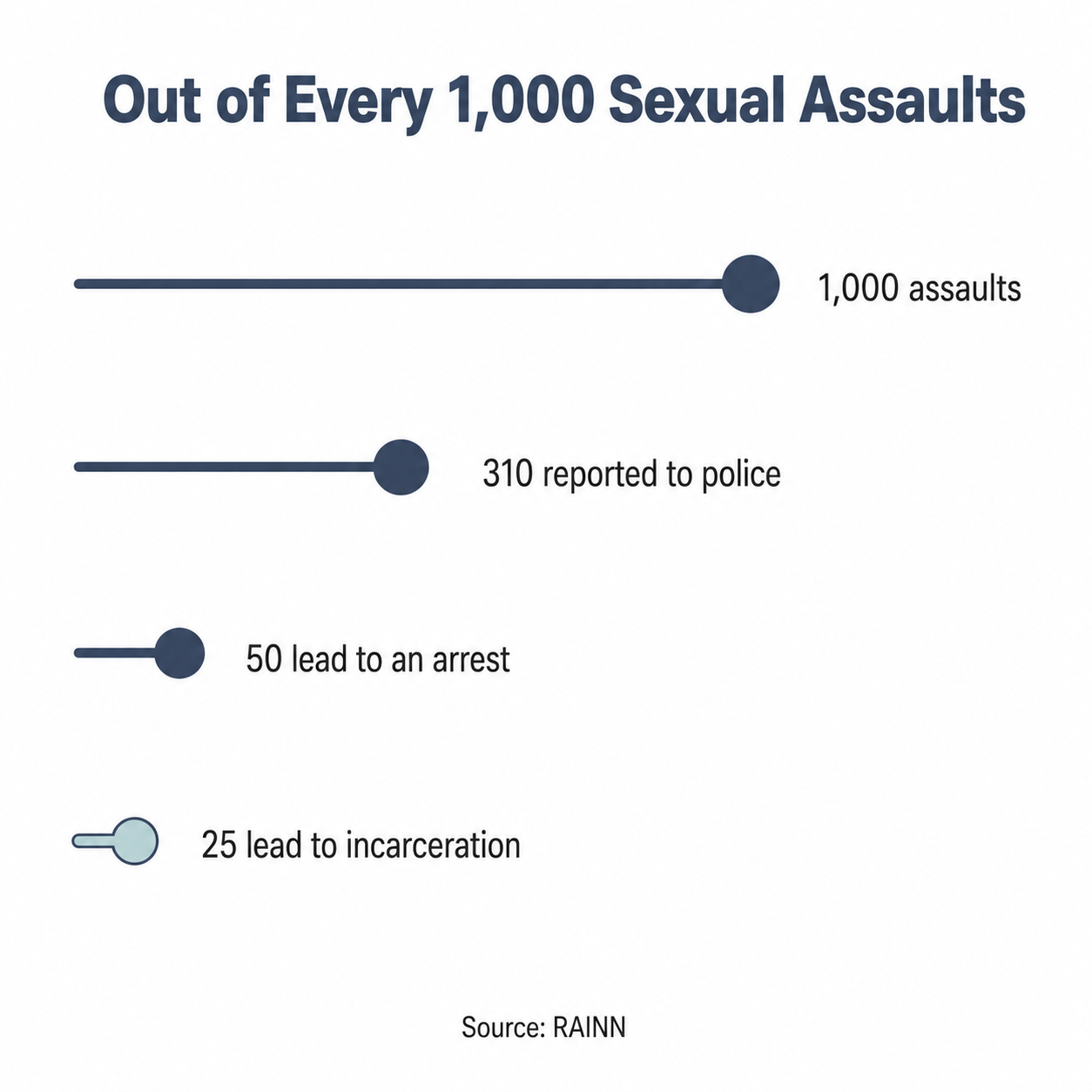
This matters because the criminal system resolves only a small fraction of sexual violence. According to RAINN, out of every 1,000 sexual assaults in the United States, about 310 are reported to police, 50 lead to an arrest, and just 25 lead to incarceration. If you measure your options only by what the criminal system did, you may write off a civil claim that remains fully available to you. We cover this in more detail in our article on the benefits of bringing a civil claim as a survivor.
Why a General Personal Injury Lawyer Isn't Enough
The category answer (personal injury lawyer) is accurate but incomplete. Within personal injury law, sexual abuse litigation is a distinct discipline, and the biggest difference is institutional liability.
Civil sexual abuse claims frequently reach beyond the individual abuser to the school, church, daycare, youth program, or sports organization that enabled or ignored the abuse. Because an abuser's intentional act generally falls outside the scope of their employment, these cases are usually built on the institution's own negligence:
Negligent hiring: failing to screen an employee or ignoring red flags before putting them in a position of access
Negligent supervision: failing to oversee the person's conduct with children or vulnerable people
Negligent retention: keeping a known risk in their role after warnings or complaints
Failure to report: ignoring mandatory child abuse reporting duties, which can be powerful evidence of institutional fault
Negligent security: for property owners whose inadequate safety measures enabled an assault
Proving these claims comes down to showing the institution knew or should have known about the risk. That is document-intensive work: prior complaints, personnel files, background check records, policies, and supervision logs, often obtained through hard-fought discovery against defendants with experienced legal teams.
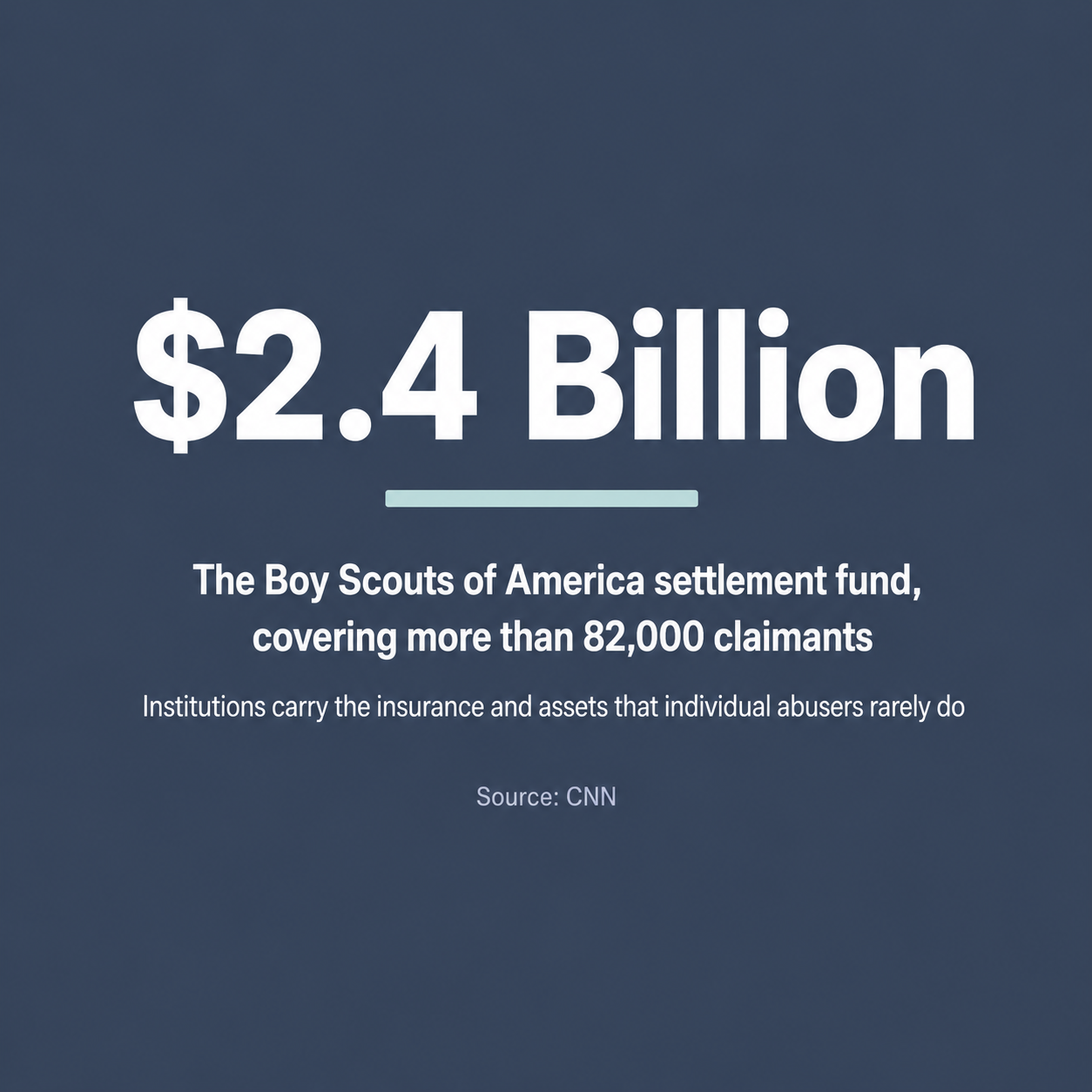
There is also a practical reason institutional accountability matters. Institutions carry insurance and hold assets that can actually satisfy a judgment; individual abusers often do not. The Boy Scouts of America settlement, one of the largest sexual abuse settlements in U.S. history, was established at $2.4 billion covering more than 82,000 claimants.
A lawyer who handles car accidents can be excellent at their job and still have no experience with any of this. When you search for representation, the question to ask is whether the attorney has sued institutions in sexual abuse cases, and whether they have taken those cases to trial.
What Does a Sexual Abuse Lawyer Actually Do?
A qualified sexual abuse lawyer manages the entire civil process so the survivor never has to face any of it alone:
Confidential consultation. The process starts with a free, private conversation to understand what happened and whether a claim is viable. There is no obligation to move forward.
Investigation. The lawyer gathers evidence of both the abuse and the institutional failures around it, including records the institution would prefer stay buried.
Identifying every liable party. This often includes defendants a survivor would never think to name, such as a national parent organization or a property owner.
Protecting the survivor's privacy. Experienced attorneys move for pseudonym filings (proceeding as "Jane Doe" or "John Doe"), sealing, and protective orders where the court allows.
Handling all communication. The survivor never has to speak to the abuser's lawyers or the institution's insurance company.
Negotiating or trying the case. A strong lawyer prepares every case as if it will go to trial, which is also what produces stronger settlement offers.
Claims involving teachers and schools, clergy, daycares, and youth sports each carry their own legal issues, which is another reason experience in this specific area matters.
Can You File a Sexual Abuse Lawsuit Anonymously?
Often, yes, but it is not automatic. Ohio courts default to open records, and filing under a pseudonym requires a motion that must be argued and granted. Courts have granted these motions in many sexual abuse cases and denied them in others.
In the U.S. Twirling Association trial mentioned above, the survivor proceeded as "Doe" through a federal jury trial. An experienced sexual abuse lawyer will have a concrete strategy for identity protection, including pseudonym motions, redaction of personal identifiers, and protective orders, and will be honest with you about what the court is likely to allow.
How Long Do You Have to File in Ohio?
Ohio's filing deadlines are strict, and they are one of the most important reasons to speak with a lawyer early.
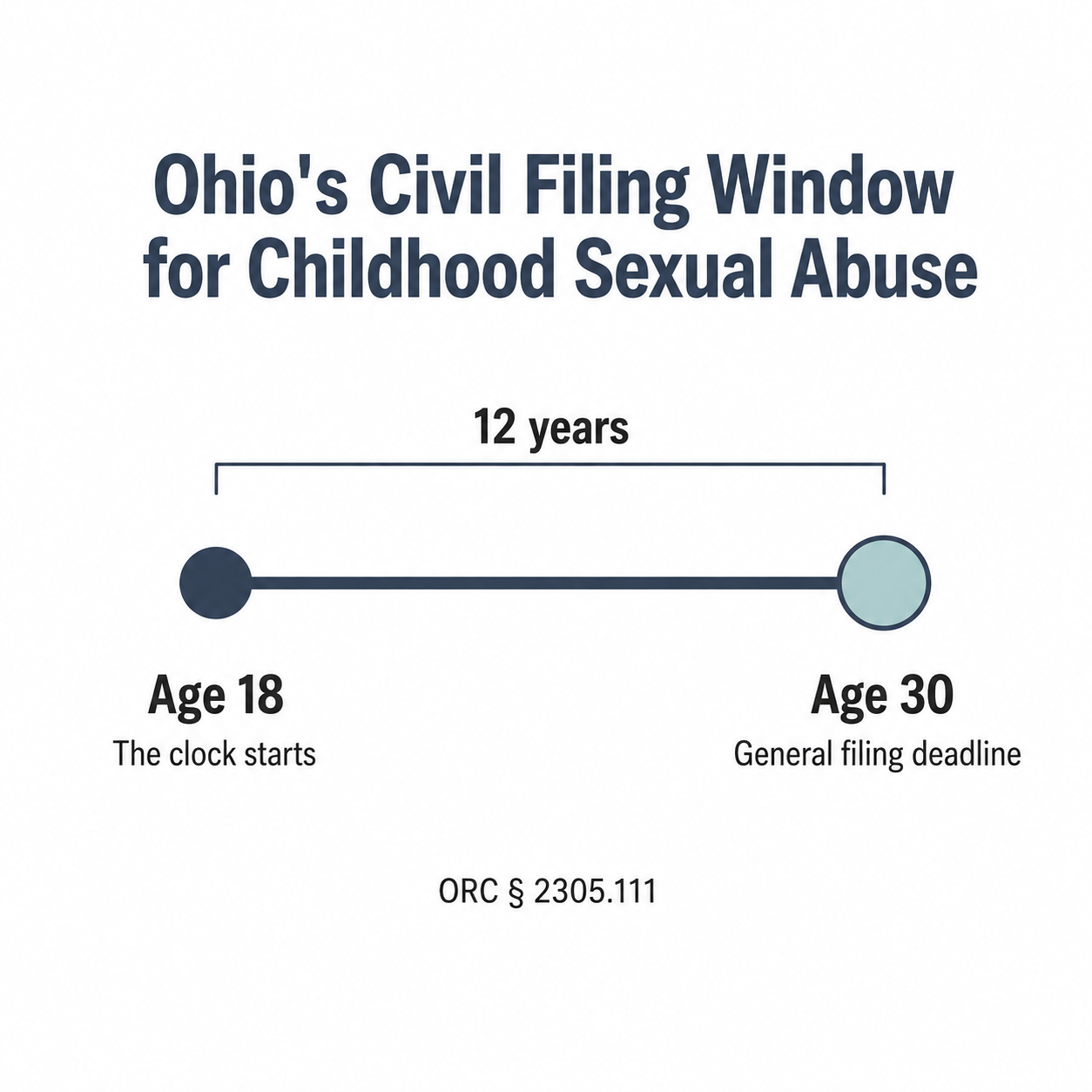
For childhood sexual abuse, Ohio law generally gives survivors 12 years after they turn 18, meaning most survivors have until their 30th birthday to file (R.C. 2305.111). Ohio law does not include a repressed-memory exception that pauses the clock until memories surface, as the Ohio Supreme Court has confirmed.
Survivors of childhood abuse take an average of about 20 years to disclose what happened, according to CHILD USA. Many survivors first feel ready to come forward after the window has already closed.
For adult survivors, deadlines can be even shorter, in some cases as little as one year depending on how the claim is framed and who it is brought against.
Exceptions exist. For example, if a defendant fraudulently concealed facts about the abuse, the deadline can be extended. But exceptions are narrow and fact-specific. The only reliable way to know your deadline is to have a lawyer analyze your specific situation, and the sooner that happens, the more options remain open. Speaking with an attorney starts no clock and creates no obligation.
What Does It Cost to Hire a Sexual Abuse Lawyer?
Nothing upfront. Sexual abuse cases are handled on a contingency fee basis, which means:
You pay no fees or costs to start your case
The attorney's fee comes out of the compensation recovered
If there is no recovery, you owe no attorney fee
The initial consultation is free and confidential
The American Bar Association confirms contingent fees are the standard arrangement in personal injury matters. Before you sign with any lawyer, ask for the fee agreement in writing, ask what percentage applies and whether it changes if the case goes to trial, and ask who advances case expenses. A trustworthy attorney will answer all of it plainly.
What Compensation Can Survivors Recover?
Compensation in a civil sexual abuse case generally falls into three categories:
Economic damages: therapy and counseling costs, medical care, lost income, and diminished earning capacity
Non-economic damages: pain and suffering, emotional distress, and loss of enjoyment of life, often the largest component in abuse cases
Punitive damages: available in cases of especially egregious conduct, including institutional cover-ups
The value of any individual case depends on its specific facts, and Ohio law on damages is complex. You can read more on our damages page, but the honest answer is that no article can tell you what your case is worth. A consultation can.
How to Choose a Sexual Abuse Attorney
Once you know the category of lawyer to look for, the real work is separating attorneys with genuine sexual abuse litigation experience from those who list it as one practice area among twenty. Ask these questions:
How many sexual abuse civil cases have you handled, and what were the outcomes?
Have you sued institutions, not just individual abusers?
Have you taken sexual abuse cases to trial and won verdicts, or only settled?
How will you protect my identity during the case?
Do you understand Ohio's filing deadlines and their exceptions?
Is your team trained to work with survivors in a trauma-informed way?
Are you personally involved in the survivor community?
The red flag is a lawyer who cannot point to specific sexual abuse cases they have litigated, or who treats your case like a routine injury claim.
These criteria are the standard we hold ourselves to. Andy has practiced for more than 25 years and brings particularized expertise in sexual abuse cases, including the $4.2 million U.S. Twirling Association verdict, recognized as the 35th highest verdict in New York in 2025. He serves on the Board of Directors of the Cleveland Rape Crisis Center, where he chairs the governance committee, and is a member of the National Crime Victim Bar Association, the American Board of Trial Advocacy, and the National Trial Lawyers Top 100 for civil plaintiff attorneys.
From the very first call, clients also work with Quenna Bell, a certified Cleveland Rape Crisis Center Ambassador trained in supporting survivors of sexual violence. For cases involving minors, our child sexual abuse practice is a core focus of Andy's work.
Talk to an Ohio Sexual Abuse Lawyer
If you are trying to figure out whether you have a case, you don't have to figure it out alone. We offer free, completely confidential consultations, and Andy personally evaluates every potential case. There is no fee unless we win, and no obligation after we talk.
Request a free, confidential consultation
Or call Andy's office directly: (216) 658-9900