
Written by Andy Goldwasser, Managing Partner, Ciano & Goldwasser, LLP

If a priest, pastor, youth leader or other church worker in Ohio sexually abused you or your child, the church can be sued along with the abuser. The church is not responsible just because the abuser worked there. It is responsible for its own failures, such as keeping someone on after being warned about them.
Ohio's deadline to sue is strict: a lawsuit over childhood sexual abuse generally has to be filed by the survivor's 30th birthday.
I'm a personal injury attorney at Ciano & Goldwasser, LLP with a focus on sex abuse cases, including abuse by clergy and church workers. I also serve on the Board of Directors of the Cleveland Rape Crisis Center, where I chair the governance committee.
Who can you sue for sexual abuse at a church in Ohio?
In Ohio, a lawsuit over sexual abuse at a church can name the abuser and the church organizations responsible for the abuser. Which organizations belong in your case depends on who hired, supervised and was warned about the abuser. They can include:
The parish or local church
The diocese or archdiocese
The denomination or its regional body, such as a United Methodist conference
A religious order, when the abuser was a member of one
A church-run school, daycare or children's home
The same rules apply to every denomination, and Ohio survivors have sued Grace Brethren and United Methodist churches as well as Catholic dioceses.
Does religious freedom or charity status protect a church?
Charity status does not protect an Ohio church from being sued. Ohio courts once gave charities a limited shield from some injury lawsuits, but the Ohio Supreme Court ended it in 1984, in Albritton v. Neighborhood Centers Association for Child Development, and confirmed in 1991, in Byrd v. Faber, that it no longer protects churches. A church also can't avoid responsibility because the abuser was a volunteer: the limited protection Ohio gives charity volunteers does not extend to the church itself.
Religious freedom does not protect a church's decision to hire someone it knows is likely to commit crimes or cause harm, the court said in Byrd. What religious freedom does affect is how specific your lawsuit has to be. Because the First Amendment limits how far courts can look into a church's hiring decisions, the Ohio Supreme Court requires a claim that a church was careless in hiring someone (called negligent hiring) to state specific facts about what the church knew, or could have found out, about that person. A lawsuit that only accuses the church in general terms, without those facts, can be thrown out.
What do you have to prove to hold a church responsible?
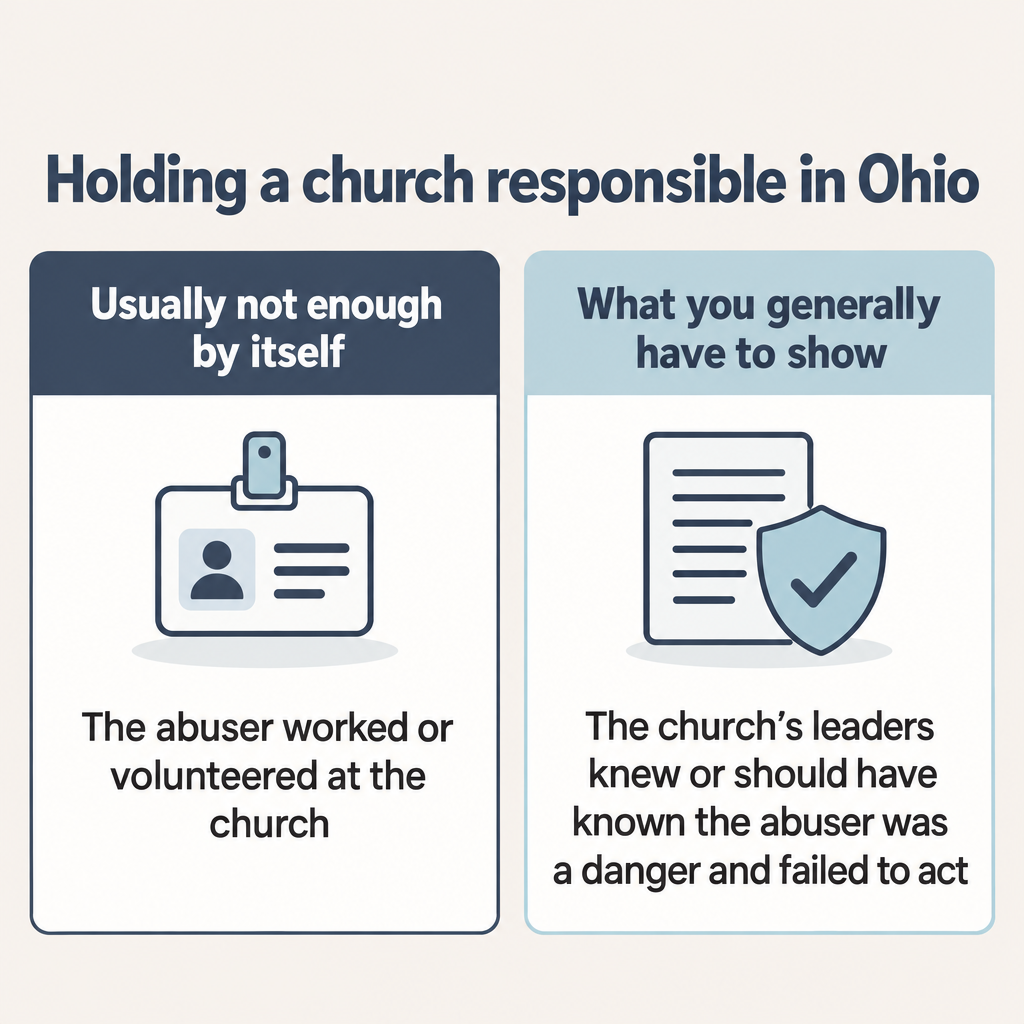
To hold a church responsible in Ohio, you generally have to show that its leaders knew or should have known the abuser was a danger and failed to act. The fact that the abuser worked or volunteered at the church is usually not enough by itself. In Byrd, the Ohio Supreme Court held that a church was not automatically responsible for its pastor's sexual misconduct just because he worked for it.
A lawsuit over sexual abuse at a church can include claims for:
Negligence, when the church failed to take reasonable care to protect children
Negligent hiring, retention and supervision: hiring the abuser, keeping the abuser on, or failing to supervise the abuser after warning signs
Failing to report abuse that Ohio law required church leaders to report
Assault and battery, against the abuser
ORC 2307.60, which lets anyone hurt by a criminal act sue for full damages, unless another law makes an exception
Title IX, in some cases involving a church-run school
In 2008, a 15-year-old girl was sexually assaulted by her pastor in his office at Sunbury Grace Brethren Church. That church settled before trial. The church a jury held responsible was a different one: Grace Brethren Church of Delaware (Delaware Grace), which had employed him for years before he started the Sunbury church. The Ohio Supreme Court's decision in Simpkins v. Grace Brethren Church of Delaware sets out what Delaware Grace knew and did:
1988: Delaware Grace hired him, first as youth pastor and later as associate pastor.
Early 1990s: A teenage girl on a church mission trip accused him of inappropriate touching.
2002: A young woman made substantiated allegations of inappropriate sexual comments and touching. A pastor at Delaware Grace knew of them and told neither the senior pastor nor the church's elder board.
2004: He started the Sunbury church with Delaware Grace's support. Delaware Grace was its main financial backer, and a Delaware Grace pastor supervised him there for at least a year.
2008: He sexually assaulted the 15-year-old in his church office. He later pleaded guilty to two counts of sexual battery.
Trial: A jury found Delaware Grace liable for negligent hiring, retention and supervision.
Survivors often worry that the church will be believed over them. Your own account matters, and what church leaders knew can also be shown in other ways: through the people you or your parents told, complaints by others, church or diocese records, and whether the abuser was moved after complaints. In Simpkins, the case rested on warnings the church had received years before the assault. Because Ohio courts require specific facts about what a church knew, what you remember about who was told, and when, can matter a great deal.
How long do you have to sue a church in Ohio?
How much time you have depends on how old you are now, when the abuse happened and who the abuser was. For childhood sexual abuse, Ohio's deadline to sue is generally the survivor's 30th birthday, whether the lawsuit is against the abuser or the church. ORC 2305.111 gives survivors 12 years after they turn 18 to bring "any claim resulting from childhood sexual abuse." In 2020, an Ohio appeals court held that this deadline covers claims against an organization, a private school in that case, and not only claims against the abuser.
The 12-year rule always covers rape and sexual battery. It covers other sexual contact, such as unwanted touching, only in situations the statute lists, most of them based on the abuser's role. A cleric abusing a child who belongs to or attends his church is one of those situations.
| Your situation | Where you stand |
|---|---|
| You are under 30 | You generally have until your 30th birthday. |
| Your child was abused | The deadline for your child's claim generally runs to your child's 30th birthday. |
| You are over 30, and the abuse happened on or after August 3, 2006 | The deadline may be paused if the church or the abuser deliberately hid facts your claim depends on, such as earlier complaints about the abuser. The pause lasts until you discovered those facts, or reasonably should have. |
| You are over 30, and the abuse happened before August 3, 2006 | Under current law, the claim has most likely expired. Learning years later that there were other victims, which can suggest the church knew, has not reopened these claims (Doe v. Archdiocese of Cincinnati, 2006). |
| The abuser was not a cleric, and the abuse was sexual contact other than rape or sexual battery | The 12-year rule still applies if the abuser held a role the statute lists, such as a coach, instructor, scout leader or anyone with temporary or occasional disciplinary control over the child. If not, a claim against the abuser generally must be filed within one year after the child turns 18, and a claim against the church may also have a shorter deadline. |
| You were an adult when the abuse happened | An assault or battery claim must be filed within one year. A negligence claim against a church may have a different deadline. |
| You are waiting for the bill being drafted in the Ohio legislature | It is not law. As of early November 2026, it had not been introduced. |
If you are past the deadline, you are far from the only survivor in that position. An Ohio legislative working group, in a report quoted by WCPO, said that "Many survivors delay reporting sexual violence due to trauma, fear, power dynamics or lack of supportive resources."
The bill being drafted would change these deadlines if it passes. Sen. Bill Blessing (R-Colerain Township) and Rep. Rachel Baker (D-Cincinnati) want to end the time limits for suing abusers and the institutions accused of protecting them, FOX19 reported. According to WCPO, the bill would also open a "look-back window": a set period when survivors whose deadlines have passed could still file. How long that window would last has not been reported. Unless a bill like this passes, the current deadlines apply, so don't wait for it.
Because the right deadline depends on these details, I'd encourage you to talk with us before assuming it is too late. We can tell you honestly whether any route remains in your situation.
Did the church have to report the abuse?
Under Ohio law as it stands today, clergy and church leaders acting in their church role must report child abuse by another cleric or church leader. If you were abused years ago, the abuse may have happened before parts of this law were in place. ORC 2151.421 sets out the duty as it is now:
Who must report: clergy and people a church has designated to act as its leaders, officials or delegates, while they are acting in their official or professional role for the church. Volunteers do not have this duty.
When it applies: when they know, or have reasonable cause to believe, that another cleric or church leader abused a child. Abuse by a volunteer does not trigger this duty.
Who they report to: the county's children services agency or the police.
How fast: immediately.
If a volunteer abused you, this duty may not have applied, but claims for careless hiring and supervision still can. Church employees who work as teachers or daycare workers may also have their own duty to report under the same law.
The law also makes an exception for confession. A cleric does not have to report what he hears in a confession made directly to him when his church's doctrine or canon law treats that confession as absolutely confidential, as the Catholic Church does. That holds even for a child: if a child tells a priest in confession that he or she is being abused, the law does not require the priest to report it. When an adult, such as a parent, is the one speaking, the exception is wider: it can also cover what the adult tells a cleric in confidence for religious counseling.
Failing to make a required report is a misdemeanor. It can also be the basis of a lawsuit: the child the report should have protected can sue the person who failed to make it, for the harm caused and for an added amount meant to punish.
In January 2026, two sisters sued several Dayton-area United Methodist churches and church bodies. According to the suit, as reported by The Roys Report, their father and stepmother raised concerns in 2014 with the pastor of St. Andrew United Methodist Church in Beavercreek about the church's music director. The pastor told them the music director denied it. The music director kept his job and was later transferred to Parkview United Methodist Church in Miamisburg, where one of the sisters says he abused her from 2015, when she was 13, through 2017. The suit says the churches ignored warning signs, failed to stop or report the abuse, ignored the denomination's Safe Sanctuary policy for protecting children and violated Ohio's reporting law. It names the two local churches, their district, the West Ohio Conference and a national United Methodist agency, among others. The suit's claims are allegations.
What if the abuser was never charged, or has died?
You can sue the person who abused you even if that person was never charged with a crime. A civil lawsuit is separate from any criminal case. In 2020, the Ohio Supreme Court ruled that a lawsuit under ORC 2307.60, Ohio's law on suing over a criminal act, does not require a criminal conviction, Court News Ohio reported. The claim against the church does not depend on a charge or conviction either. Our guide to sexual assault victims' rights in Ohio explains how civil and criminal cases differ.
If the abuser has died, a claim against the church can still go forward, because it rests on the church's own failures. In 2020, the Catholic Diocese of Columbus paid $1 million to settle a lawsuit by a former St. Charles Preparatory School student, who said a priest who taught there abused him in 2002 and 2003. The priest had died in 2008, ten years before the lawsuit was filed. Neither side admitted wrongdoing as part of the settlement, WOSU reported.
What compensation can you get from a church?
Compensation in a case against a church can cover two kinds of harm. The first is financial loss, such as the cost of counseling and lost income. The second is harm that is not financial, such as pain and suffering and emotional distress.
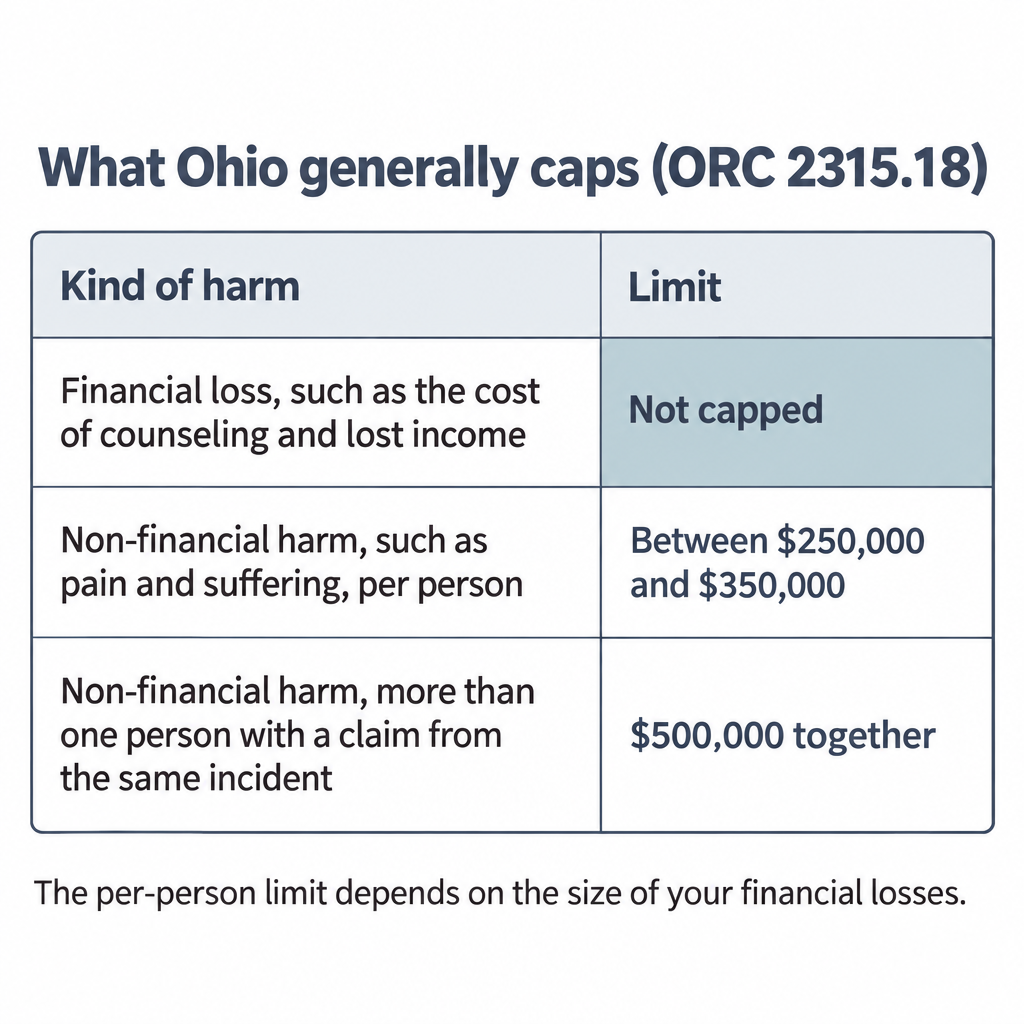
Ohio generally caps the second kind. Under ORC 2315.18, the limit for non-financial harm is between $250,000 and $350,000 per person, depending on the size of your financial losses. When more than one person has a claim from the same incident, such as a child and a parent, their non-financial damages together are limited to $500,000. Financial losses are not capped.
The cap was applied against the church in Simpkins. The jury awarded the girl about $3.65 million, including $3.5 million for non-financial harm. The court cut that part to $350,000. With about $150,000 for her financial losses, her judgment came to about $500,000, and the Ohio Supreme Court upheld the result in 2016. Parents can have a claim of their own: the jury awarded her father $75,000 for the harm to his relationship with his daughter.
In 2022, in Brandt v. Pompa, the Ohio Supreme Court struck down the cap for survivors of child sexual abuse with permanent and severe psychological injuries who sue the person found guilty of abusing them. The court has not decided whether that ruling applies to a negligence claim against a church, so the cap may still apply in a case against a church.
Who pays can depend on insurance. The Columbus settlement came from the diocese's general liability insurance fund. When a policy excludes abuse, the church still has to pay: World Harvest Church settled a case over a daycare worker's physical abuse of a toddler for about $3.1 million, and in 2016 the Ohio Supreme Court held that its insurer did not have to cover the church's liability.
Figures from past cases are examples, not predictions. What a case may be worth depends on its facts, and no lawyer can honestly promise an amount.
Can you file the lawsuit without using your name?
You can ask the court for permission to file as "Jane Doe" or "John Doe," but Ohio courts allow it only in exceptional circumstances. In 2024, the appeals court for Cuyahoga County wrote that "It is the rare exception for a litigant to be allowed to proceed anonymously." The sisters suing the United Methodist churches filed as "Jane Doe" and "Mary Doe."
Is it wrong to sue your own church?
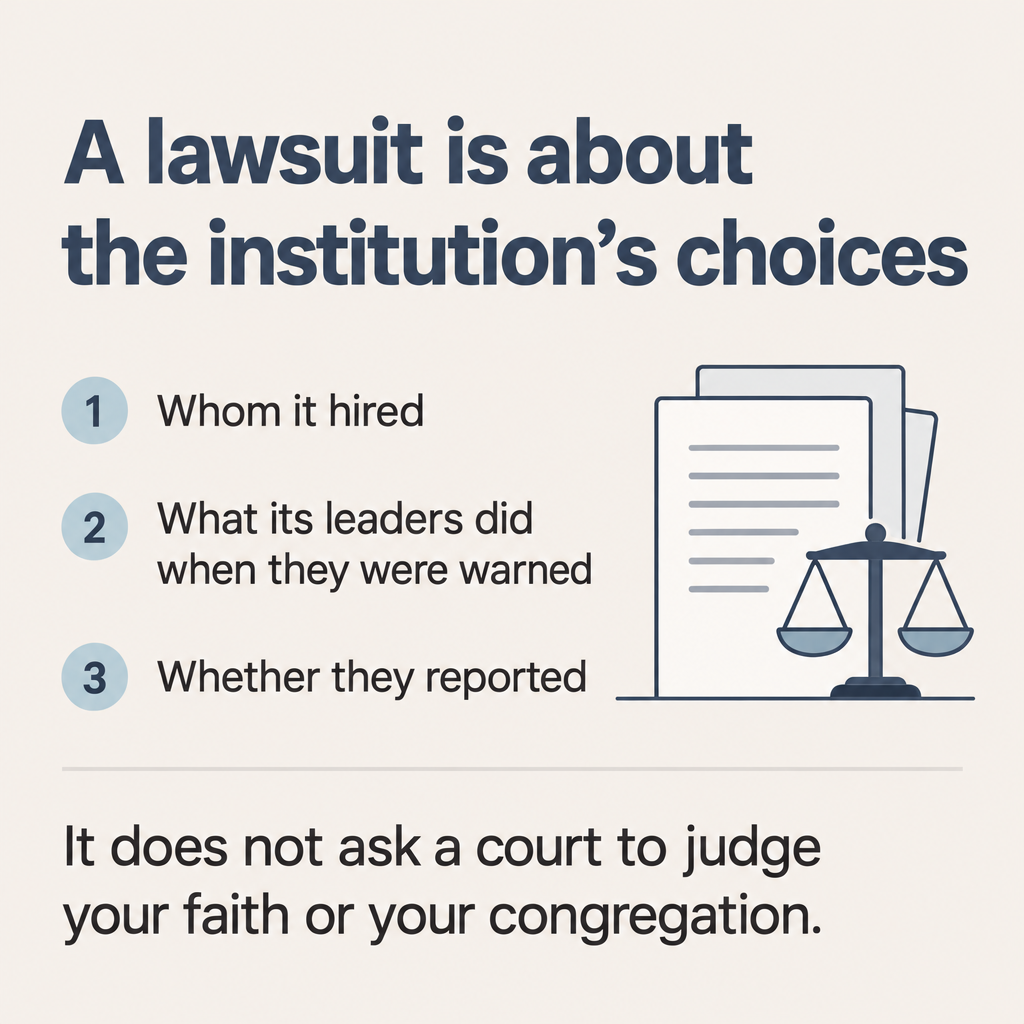
Many survivors feel torn about suing a church they or their family still belong to. A lawsuit is about the institution's choices: whom it hired, what its leaders did when they were warned, and whether they reported. It does not ask a court to judge your faith or your congregation. The people it seeks to hold responsible are the ones Claudia Vercellotti of SNAP, the Survivors Network of those Abused by Priests, described: "It's not just the sexual predator. It's those who knew or should have known and provided cover."
Some survivors also fear how their parish or family will react. The former St. Charles student who sued the Columbus diocese told WOSU, "In a fairly Catholic community, it wasn't something we talked about." You decide whether to take any step, and when. Our consultations are free and confidential.
Others worry that a lawsuit could bankrupt their church. Sen. Blessing, quoted by WCPO, answered that worry this way: "What are we saying here? That justice cannot be done because somebody might go bankrupt or might lose money?" Ohio's Catholic dioceses have paid settlements without going bankrupt: none has filed for bankruptcy, according to a list kept by The Catholic Project at The Catholic University of America.
What should you do first?
Whether or not you decide to sue, a few steps protect a child who may be at risk and preserve what you know:
If a child may be in danger now, report it to your county children services agency or the police. Go to them directly rather than to church officials.
Write down what you remember. Include what happened, where and when, and who at the church was told or saw warning signs, with dates as best you can.
Keep anything from that time. Letters, emails, texts, photos, church directories and anything you have received from the church or diocese can all help.
If the abuser was a Catholic priest, check the diocese's list. Ohio's six Roman Catholic dioceses each publish a list of clergy they consider credibly accused, and BishopAccountability.org collects them. A name on the list tells you the diocese itself considers accusations against that priest credible.
Don't sign anything from the church, the diocese or its insurer before you get legal advice. Anything you sign could affect your right to sue. Dioceses also run victim assistance programs, which are separate from a lawsuit and may offer counseling. In 2024, the Diocese of Toledo set up a separate compensation program to pay three survivors of a former priest outside court. The same caution about signing applies to any of these programs.
Talk to a lawyer soon. The age-30 deadline keeps running while you decide. If you're weighing who to call, our article on what kind of attorney handles sexual abuse cases covers what to look for.
If you need support right now, apart from any legal decision, our survivor resources page lists places to start.
If you were abused by someone at a church in Ohio, or your child was, I would be glad to talk with you about what happened and whether the church can be held responsible. A consultation with our firm is free and confidential, and it does not commit you to anything. If you decide to move forward, we handle these cases on a contingency basis under our No Fee Guarantee: you pay nothing up front and no fee unless we win. You can reach our Beachwood office at (216) 658-9900 or send us a message.