Written by Andy Goldwasser

If a coach sexually abused your child, or abused you when you were a young athlete, you can bring a civil claim in Ohio against the club, league or sports organization behind the team, as well as against the coach. The claim against the organization depends on what it knew, or should have known, about the coach and what it did about it.
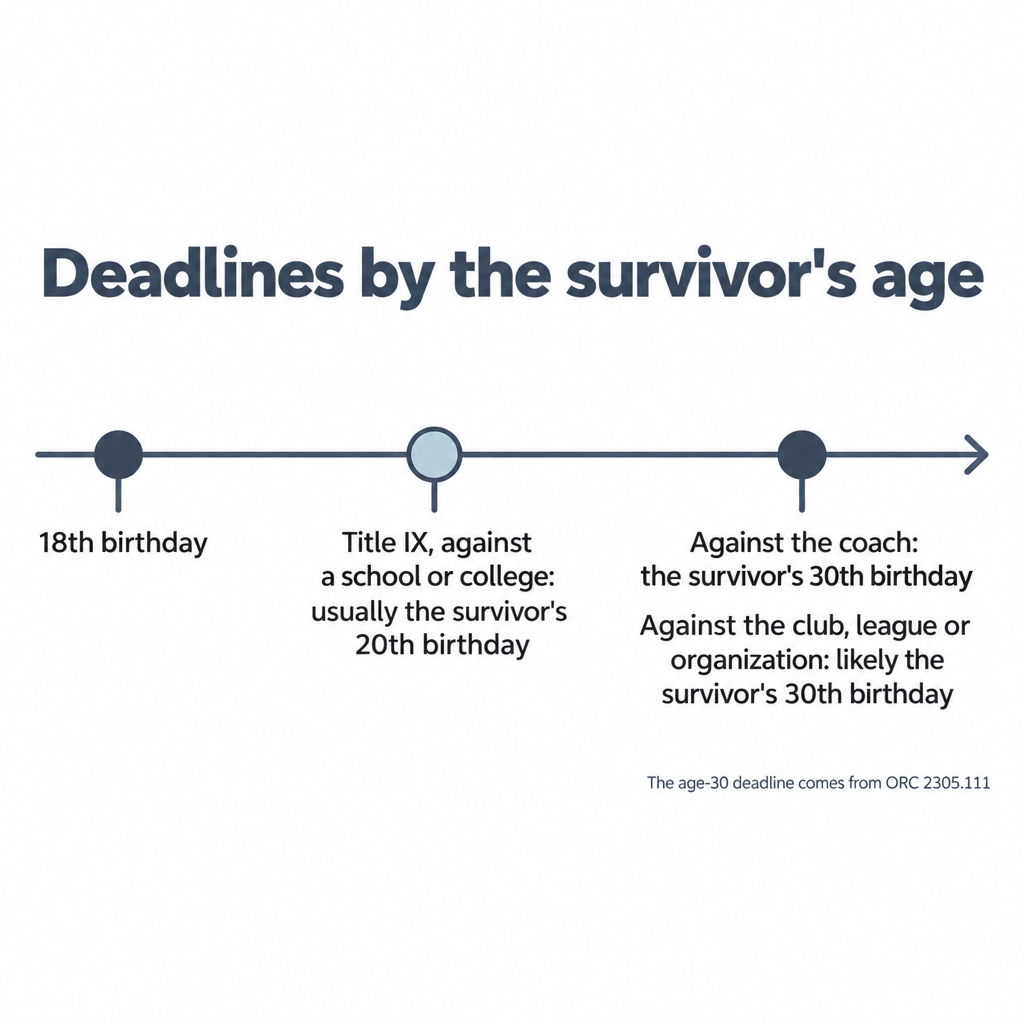
Most of these claims must be filed by the survivor's 30th birthday. If the team was run by a school or college, you may also have a claim under Title IX, a federal law, and that one claim has a much shorter deadline: two years, usually counted from the survivor's 18th birthday.
I'm a personal injury attorney at Ciano & Goldwasser, LLP, with a focus on sex abuse cases, and I serve on the Board of Directors of the Cleveland Rape Crisis Center, where I chair the governance committee. Our firm brings civil claims against sports organizations, schools and other institutions that failed to protect the young people in their care.
What has to be proven to hold a youth sports club responsible?
To hold a club, league or sports organization responsible for a coach's sexual abuse, you generally have to show that it knew, or should have known, that the coach was a danger to young athletes and failed to act. Ohio law calls these claims negligent hiring, negligent supervision and negligent retention. When we investigate a claim against a club, the questions match those three claims:
Hiring: Did the club check the coach's background, including whether another organization had banned or suspended the coach?
Supervision: Did the club have rules limiting one-on-one time between coaches and young athletes, and did it enforce them?
Retention: Did parents, players or staff raise concerns about the coach, and did the club keep the coach on, or let the coach move to another team, after that?
A club is usually not responsible just because the coach worked for it. In general, an employer is responsible for harm an employee causes while doing the job. Sexual abuse is no part of what a coach is hired to do, so that rule usually does not apply. In Pryor v. Ohio State University, a former diver sued the university over abuse by an assistant coach in its diving club. In August 2026, the Ohio Court of Claims held that the coach's sexual misconduct was a "clear departure" from his job.
The court also found that she had not shown the university knew, or should have known, about the coach's alleged past conduct with other divers. That ruling was based on the evidence in her case. It does not mean a club can never be held responsible.
Can you also sue the coach?
You can sue the coach directly, and the usual claim is assault and battery.
Ohio's criminal laws name coaches directly. Under the sexual battery law, Ohio Revised Code (ORC) 2907.03, sexual conduct between a player under 18 and the player's own coach is a crime. Ohio's grooming law, ORC 2907.071, which took effect in April 2025, makes it a crime for an adult to engage in a pattern of conduct meant to entice or prepare a minor for sexual activity. For most adults the grooming law protects children under 16, but when the adult is the child's coach, it covers players under 18. Our article on Ohio's grooming law explains what grooming is.
Because the abuse is a crime, you can also sue the coach under ORC 2307.60, which lets anyone "injured in person or property by a criminal act" recover "full damages" in a civil lawsuit. The civil case is separate from any criminal case, and the coach does not have to be convicted first. In Buddenberg v. Weisdack, the Ohio Supreme Court held in 2020 that the statute's plain language "does not require proof of an underlying criminal conviction."
A lawsuit over abuse by a coach can include claims against both the club and the coach:
Negligence, against the club, for failures beyond hiring and supervision, such as not acting on a report of abuse
Negligent hiring and supervision, including negligent retention, against the club
Assault and battery, against the coach
A claim under ORC 2307.60, against the coach, for injury caused by a crime
Title IX, a federal law that applies to schools and colleges, against a school or college that ran the team (the claim with the two-year deadline)
Does a waiver you signed stop a lawsuit?
A waiver you signed at registration may block some claims against the club, depending on whether the club is a nonprofit and on the form's wording. It is unlikely to block your claim against the coach for the abuse.
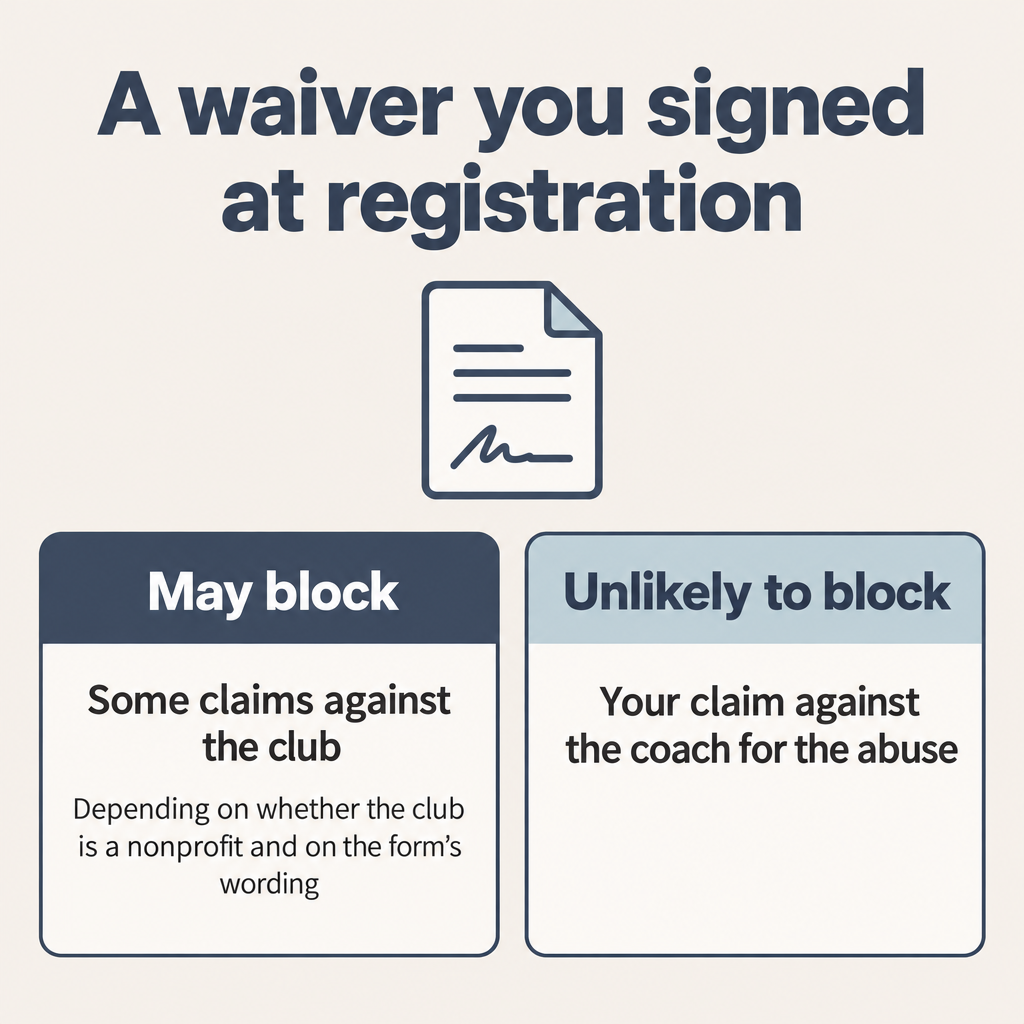
The leading Ohio case is Zivich v. Mentor Soccer Club, which the Ohio Supreme Court decided in 1998 after a child was hurt on a soccer goal. The court held that a parent can sign away some of a child's claims. The rule covers only negligence claims, meaning claims that someone was careless, and only claims against the volunteers and the organization running a nonprofit sports program. A claim that a nonprofit club supervised the coach carelessly is the kind of claim a waiver can block. Zivich does not say whether the same rule applies to a club run as a business.
Zivich did not address abuse or claims against a coach. Its rule is about carelessness, and sexual abuse is intentional, so the rule does not apply to your claim against the coach for the abuse. Because so much depends on the club and the exact wording, have a lawyer read every form you signed.
ProPublica reported in August 2026 that registration forms for the Amateur Athletic Union (AAU) require claims against the AAU to go to "confidential arbitration hearings instead of jury trials in open court," so a lawyer should check your forms for a clause like that as well.
How long do you have to sue a coach or club in Ohio?
Claim
Against
Deadline
Assault and battery, and other Ohio claims over the abuse
The coach
The survivor's 30th birthday
Negligent hiring, supervision and retention
The club, league or organization
Likely the survivor's 30th birthday
Title IX
A school or college, over a team or program it runs
Usually the survivor's 20th birthday
If the team belonged to a public school district or a city or township program, claims against the district or city may have a much shorter deadline.
The age-30 deadline comes from ORC 2305.111, which gives 12 years from the 18th birthday to sue over "childhood sexual abuse." The statute defines that term by a list of sex crimes against a child under 18, and sexual battery by the child's coach is on the list. In S.A.S. v. Wellington School, an Ohio appeals court held in 2020 that the 12-year period can apply to claims against someone other than the abuser, such as a school accused of negligent hiring, retention and supervision. It sent the case back for the trial court to decide whether what happened met the statute's definition. The statute covers "any claim resulting from childhood sexual abuse," so the same deadline should apply to a claim against a club or league.
Title IX sets no deadline of its own, so federal courts in Ohio use the state's two-year deadline for personal injury claims. For a survivor abused as a minor, the two years usually start on the 18th birthday, which puts the deadline around age 20. The former diver in the Pryor case also brought a separate federal lawsuit under Title IX. In 2025, the federal appeals court that covers Ohio applied the two-year rule to it and refused to use the 12-year period. She turned 18 in 2015 and filed in January 2022, so the court held her claim was too late. Our Title IX page explains how these claims work against schools.
If your child is under 18 now, none of these deadlines has started running. That is still not a reason to wait, because evidence about what the club knew is easiest to collect early.
If you were the athlete and you are now past 30, one rule may still help. For abuse on or after August 3, 2006, if the person or organization you would sue fraudulently hid the facts your claim is based on, Ohio law pauses the deadline until you learn those facts or reasonably should have.
In September 2026, Sen. Bill Blessing and Rep. Rachel Baker announced plans for a bill to end Ohio's civil deadline for childhood sexual abuse claims, Fox19 reported. WCPO reported on October 1, 2026, that the bill was still being drafted, and as of November 3, 2026, no such bill had been introduced. It is not law. If you think your deadline has passed, have a lawyer look at your situation before you assume it is too late.
Is a youth sports coach a mandated reporter in Ohio?
Ohio's child abuse reporting law, ORC 2151.421, does not name coaches. Its list of people who must report suspected child abuse includes school teachers, school employees and school authorities, employees of child care centers and camps, children services workers and peace officers. A coach at a private club, travel team or league is not on that list.
A separate Ohio law, ORC 2921.22, requires anyone who knows that a felony has been or is being committed to report it to law enforcement, with limited exceptions. Sexual battery of a minor by the minor's coach is a felony.
Federal law requires some club coaches to report suspected child abuse within 24 hours, depending on the kind of club. A national governing body is the national organization that oversees an Olympic or Paralympic sport. The U.S. Center for SafeSport handles abuse reports in those sports.
Kind of club
Does SafeSport cover it?
Must its coaches report suspected abuse within 24 hours?
Does federal law require limits on one-on-one contact?
A club affiliated with a national governing body for an Olympic or Paralympic sport
Yes
Yes, to law enforcement and SafeSport
Yes
Any other club, league or organization, such as the AAU or a local club
No
Only if it competes across state lines or abroad
Only if it competes across state lines or abroad and has adult members in regular contact with minor athletes
For clubs outside SafeSport, these federal rules apply to amateur sports organizations, which the law defines as nonprofits. It does not say whether a club run as a business is covered. Failing to report when the federal duty applies is a federal crime, punishable by a fine, up to a year in prison, or both.
You can report abuse yourself. Ohio law says anyone who suspects child abuse may report it, and you do not need the club's involvement to call the police or children services. When a club learns of abuse and does not report it or act on it, that failure can become part of your claim against the club.
What does SafeSport cover, and how can you check a coach?
SafeSport's FAQ says the Center has no authority over leagues outside the Olympic and Paralympic movement, and it names the AAU as one of them. A coach banned within the SafeSport system "can keep working with kids" by joining clubs or organizations SafeSport does not cover, ProPublica's guide for parents warns. To find out whether SafeSport covers your child's club, ask whether the club is a member of, or affiliated with, a national governing body.
Clubs in the SafeSport system must follow its Minor Athlete Abuse Prevention Policies, which limit one-on-one time between adults and minor athletes. Under the federal rules, one-on-one contact between an adult and a minor athlete is limited unless another adult is within "observable and interruptible distance," except in an emergency. The limits cover texts and other messages, not only time in person. If a coach regularly spent time alone with your child or messaged your child privately, write that down, because it may show the club did not enforce these limits.
Anyone can look up a coach in SafeSport's Centralized Disciplinary Database. It lists people sanctioned after a SafeSport investigation and people under temporary restrictions while an investigation is pending, so a listing is not always a final finding. The database only includes people in the Olympic and Paralympic movement, so a coach who does not appear has not necessarily been cleared.
What if the coach worked for a school or a city recreation program?
If the coach worked for a public school district or a city or township recreation program, your claim against that employer is a claim against a public body, and Ohio law protects public bodies from many kinds of lawsuits. In M.S. v. South-Western City School District, decided in August 2026, an Ohio appeals court held that this protection blocked a former student's negligent supervision claim against her school district over abuse by her teacher. The court let her claim that the district failed to report the abuse go forward.
A school district can face that claim because the reporting law lists school teachers, school employees and school authorities, and it makes anyone on its list who fails to report liable to the child. Title IX can also apply to a school or college team. Private schools are not public bodies, so this protection does not cover them. Our page on sexual abuse by teachers and school staff covers claims against schools.
What should you do if a coach sexually abused your child?
First, make sure your child is safe. Then:
Report the abuse. If your child is in immediate danger, call 911. Otherwise, report to your local police department, or call Ohio's child abuse line, 855-O-H-CHILD (855-642-4453), which connects callers to their county's children services or law enforcement office. You can make that report without giving your name.
Report to SafeSport if the club is in the Olympic and Paralympic system. Call 833-5US-SAFE (833-587-7233) or use the Center's online report form. SafeSport asks people to report to local authorities before reporting to the Center.
Write down what the club knew. Record who at the club heard concerns about the coach, when they heard them and what they did, with names and dates.
Keep everything. Save texts, social media messages, team app messages, emails, rosters, schedules, registration forms and waivers, even messages that are painful to read.
Search the coach's name in SafeSport's Centralized Disciplinary Database and save a copy of any listing.
Do not sign anything from the club or its insurer until a lawyer has looked at it.
Talk with a lawyer before a deadline gets close. A lawyer can tell you which claims apply and how long you have.
If you were abused as a young athlete and you are now an adult:
Write down what you remember about who at the club knew what, and when, and keep any messages, photos or team records you still have.
Talk with a lawyer before your 30th birthday, or soon if you are already past it.
Support is available for your child and for you. RAINN's National Sexual Assault Hotline, 800-656-4673, is free, confidential and open 24/7. The Childhelp National Child Abuse Hotline, (800) 422-4453, offers a safe place to talk for anyone affected by child abuse, though it is not a reporting line.
If a coach abused your child, or abused you as a young athlete, I would be glad to talk with you about what happened and what the club or league may have known. I review every potential case personally, and the consultation is free and confidential, with no obligation. From the first phone call, you will be working with someone trained to support survivors: Quenna Bell, our office manager and lead paralegal, is a certified Cleveland Rape Crisis Center Ambassador. Our firm also has a network of resources for survivors, built through years of involvement in the survivor community.
We handle these cases on a contingency basis under our No Fee Guarantee, so you pay no fee unless we recover compensation for you. You can reach our Beachwood office at (216) 658-9900 or through our contact form, and you can read more about how we represent survivors of abuse by coaches.